Modernisation of Zelenogorsk uranium enrichment production completed

Monday, 14 July 2025

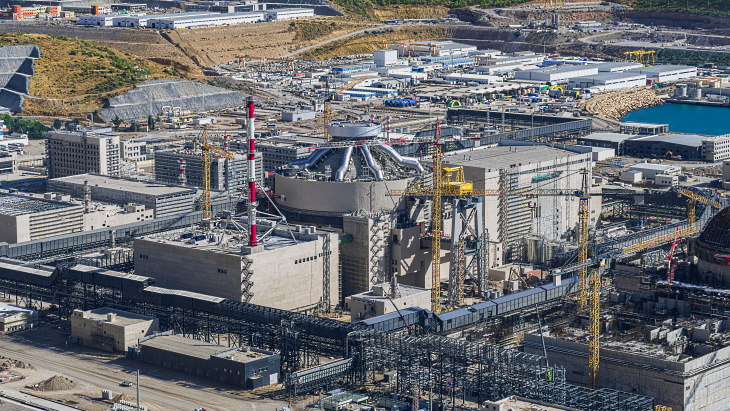
The six-year modernisation project at the Electrochemcial Plant in Zelenogorsk involved installing new generation gas centrifuges.

Modernisation of Zelenogorsk uranium enrichment production completed
(Image: TVEL)

The project was part of TVEL, Rosatom’s fuel division’s, separation equipment modernisation programme and took place with a phased replacement of previous generation gas centrifuges with generation 9+ ones, it said.

Sergey Filimonov, Director General, said: “It is symbolic that a significant historical milestone in the modernisation of the main equipment was reached in the year of the 80th anniversary of the nuclear industry. The technical re-equipment of our enterprise is significant for the successful implementation of the production programme of the Fuel Division of Rosatom in the coming years, including for providing nuclear fuel for new nuclear power units of Russian design in the country and abroad.”

Backgound

Unenriched, or natural, uranium contains about 0.7% of the fissile uranium-235 (U-235) isotope. (“Fissile” means it’s capable of undergoing the fission process by which energy is produced in a nuclear reactor). The rest is the non-fissile uranium-238 isotope. Most nuclear reactors need fuel containing between 3.5% and 5% U-235. This is also known as low-enriched uranium, or LEU. Advanced reactor designs that are now being developed – and many small modular reactors – will require higher enrichments still. This material, containing between 5% and 20% U-235 – is known as high-assay low-enriched uranium, or HALEU. And some reactors – for example the Canadian-designed Candu – use natural uranium as their fuel and don’t require enrichment services.

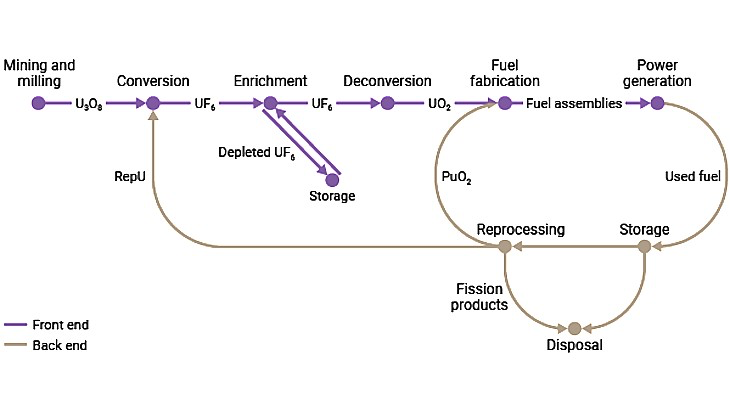
Enrichment increases the concentration of the fissile isotope by passing the gaseous UF6 through gas centrifuges, in which a fast spinning rotor inside a vacuum casing makes use of the very slight difference in mass between the fissile and non-fissile isotopes to separate them. As the rotor spins, the concentration of molecules containing heavier, non-fissile, isotopes near the outer wall of the cylinder increases, with a corresponding increase in the concentration of molecules containing the lighter U-235 isotope towards the centre. For more detail: 
   

  • Related Posts

    India begins public consultation on SHANTI Bill rules

    The SHANTI Bill – to give it its full name, the Sustainable Harnessing and Advancement of Nuclear Energy for Transforming India (SHANTI) Bill, 2025 – completed the legislative process in…

    Blue Energy, GE Vernova take gas-plus-nuclear collaboration to next stage

    In May, Blue Energy – a vertically integrated deployment platform for financeable, turnkey nuclear power plants compatible with leading reactor technology – announced it was joining up with GE Vernova…

    Have You Seen?

    UK researchers make MOF for capturing heavy metals from wastewater

    • August 18, 2026
    UK researchers make MOF for capturing heavy metals from wastewater

    US semiconductor investment tops $820bn since 2020

    • August 18, 2026
    US semiconductor investment tops $820bn since 2020

    UK biogas plant gets green light for CO2 capture and liquefaction

    • August 18, 2026
    UK biogas plant gets green light for CO2 capture and liquefaction

    Outlook for electronic specialty gases

    • August 18, 2026
    Outlook for electronic specialty gases

    10 minutes with… Airgas and Air Liquide North America CEOs

    • August 18, 2026
    10 minutes with… Airgas and Air Liquide North America CEOs

    Will Oil Prices Keep Rising?

    • August 18, 2026
    Will Oil Prices Keep Rising?

    UCLR completes first hot fire of cryogenic LOX engine

    • August 18, 2026
    UCLR completes first hot fire of cryogenic LOX engine

    Analysis: The key role of LNG in the UK North Sea debate

    • August 18, 2026
    Analysis: The key role of LNG in the UK North Sea debate

    Analysis: The key role of LNG in the UK North Sea debate

    • August 18, 2026
    Analysis: The key role of LNG in the UK North Sea debate

    India Daily: RRECL Launches RE Monitoring Tool, CSPDCL Seeks ₹2.98/kWh BESS Tariff, GERC Advances GNA Regulations, CleanMax Plans ₹400 Cr NCDs and More…

    • August 18, 2026
    India Daily: RRECL Launches RE Monitoring Tool, CSPDCL Seeks ₹2.98/kWh BESS Tariff, GERC Advances GNA Regulations, CleanMax Plans ₹400 Cr NCDs and More…