The MoU, titled “Accelerating American Leadership in Space Nuclear Power and Propulsion”, was signed on 8 October by NASA Administrator Jared Isaacman and US Secretary of Energy Chris Wright at the Science: A New Golden Age summit hosted by the White House Office of Science and Technology Policy. It will enter into force on 1 November.
“As the Golden Age of deep-space exploration begins, NASA and the US Department of Energy are advancing the development of safe, reliable, next-generation nuclear technologies for space,” NASA said, adding that the agencies will work together to “supercharge civil space exploration, unlock bold scientific discovery, and solidify American leadership in space nuclear power and propulsion”.
Isaacman said the space agency was now entering a “Nuclear-NASA era” which represents a major transformation for space exploration. “Nuclear power will allow us to go farther, operate longer, and field more capable spacecraft and instruments than ever before,” he said. “The work we’re doing today is laying the foundation for the fission-powered spacecraft of tomorrow and opening an entirely new frontier for exploration and discovery.”
NASA has been directed to develop a launch-ready lunar surface reactor by 2030 under the 2025 Executive Order on Ensuring American Space Superiority, a goal towards which the agency said it is making “steady progress” in partnership with the Department of Energy (DOE).
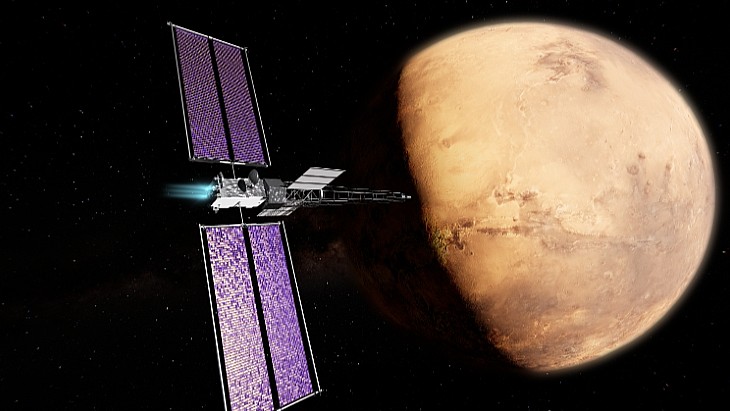
Artist’s impression of the SR-1 mission (Image: NASA)
The space agency is targeting late 2028 to launch (SR-1), which it describes as “humanity’s first fission-powered interplanetary spacecraft”. The spacecraft will demonstrate nuclear electric propulsion in space in a mission to Mars called SkyFall. SR-1 Freedom’s nuclear fission reactor will start up 48 hours into the mission, after the spacecraft has escaped Earth’s gravity. It will then navigate to Mars using electric thrusters powered by the reactor. The Skyfall scientific payload of three Ingenuity-class helicopters equipped with cameras, ground-penetrating radar, and radios to survey potential human landing sites, search for subsurface water, and relay navigation data for future landers, will be deployed in the Martian atmosphere.
SR-1 will inform and enable Lunar Reactor-1 (LR-1), a fission surface power system designed to keep NASA’s planned Moon Base operating through periods of darkness and in locations where solar power alone is not sufficient. By flying a reactor first – without the added complexity of a lunar landing – NASA says SR-1 reduces nuclear flight risk, stimulates and qualifies the supply chain, and builds the workforce necessary for future space nuclear missions.
NASA said it is also expanding its use of radioisotope power systems. These systems make use of the energy from the radioactive decay of isotopes and have been an important source of energy in space missions since 1961. NASA’s Dragonfly mission to Saturn’s moon Titan, also scheduled for launch in 2028, will rely on a Multi‑Mission Radioisotope Thermoelectric Generator and 24 Lightweight Radioisotope Heater Units to power and warm the car‑sized rotorcraft.
NASA and DOE also plan to support ESA’s (European Space Agency) Rosalind Franklin Mars rover studying the potential for past and current life on the Red Planet, by providing 24 similar heater units to maintain instrument temperatures in the extreme cold of the Martian environment.