The Canadian Manufacturers & Exporters (CME) report, , examines the economic and industrial opportunities associated with four of Ontario’s seven major nuclear project streams: the Darlington small modular reactor (SMR) project, refurbishment of the Pickering nuclear power plant, and potential reactor construction projects at Bruce C, and Wesleyville. Together, the report finds, these four projects could contribute CAD882 billion (USD617 billion) to national GDP and 3.45 million job-years, with CAD806.1 billion of GDP and 2.94 million job-years remaining in Ontario.
The projects that are the focus of the CME report are all targeted for completion in the 2030s-2040s. Construction of the first of four planned SMR units at Darlington, with all four units expected to be in service by the mid-2030s. This project is expected to add CAD38.5 billion (USD26.9 billion) to national GDP. The refurbishment of units 5 to 8 Ontario Power Generation’s (OPG) Pickering plant began in September, with completion expected in 2031-2032, and is expected to add CAD41.6 billion to GDP.
Bruce C – a potential large-scale reactor project for which a CAD300 million pre-development agreement was signed in May – could be under construction from the late 2020s to the mid-2040s, subject to approvals, and bring CAD259.6 billion of GDP. And OPG’s potential construction of large-scale nuclear at Wesleyville/Port Hope, construction from the early 2030s to the mid-2040s, subject to approvals, would bring USD541.8 billion to Canada’s GDP.
The three other projects making up Ontario’s seven nuclear project streams as listed in the report are: the refurbishment of units at the Darlington plant, which was completed in February this year; the Bruce Power life extension and Major Component Replacement project, which is already under way, and a potential second refurbishment of units 1 and 2 of the Bruce nuclear power plant in the 2040s.
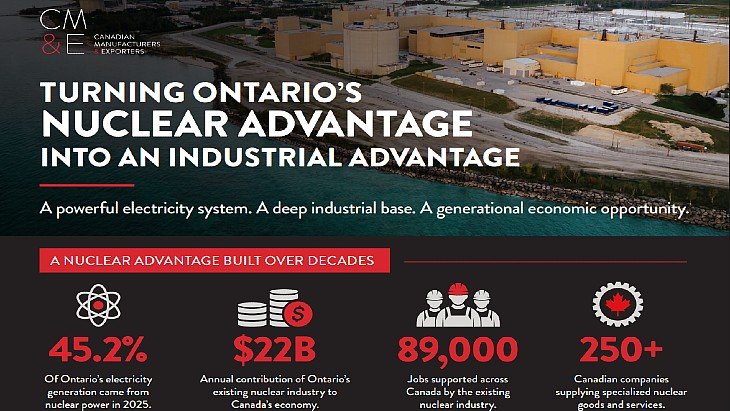
Ontario is entering this next phase of nuclear projects with an established industrial base, an existing nuclear industry that contributes some CAD22 billion annually to Canada’s economy and supports 89,000 jobs across the country, the report notes, with opportunities that extend beyond established nuclear suppliers. There is also a significant global opportunity: illustrative estimates in the report suggest that meeting the nuclear export objectives outlined in Canada’s Nuclear Energy Strategy could generate an additional CAD48 billion to CAD97 billion in Canadian GDP.
“Ontario has a tremendous opportunity to turn its nuclear investments into decades of manufacturing growth, skilled employment, and export success,” said Dennis Darby, President and CEO of CME. “We already have a strong nuclear industry and an established domestic supply chain. By building on these strengths and working together, government and industry can ensure that Canadian manufacturers capture the full benefits of this historic investment.”
“With long-term planning, strong industry-government coordination, and continued support for domestic suppliers, manufacturers will have the confidence to invest in new facilities, advanced technologies, and workforce development,” Darby said.
The report was commissioned by Ontario’s Nuclear Advantage (ONA), a coalition of industry, labour, and supply-chain members which describes itself as “dedicated to creating a balanced and factual conversation on the Ontario nuclear industry’s proud history and promising future”.
“Ontario has been building its nuclear advantage for decades, and this report shows what that advantage means for working families and communities across the province,” said Julie O’Driscoll, Executive Director of ONA. “Every refurbishment, every new reactor and every SMR creates jobs for skilled trades, engineers and manufacturers here at home. We commissioned this report so Ontarians can see the facts: nuclear is powering our economy, not just our homes.”
Canadian Manufacturers & Exporters is a national community of manufacturers founded in 1871. It notes that the findings, analysis, and conclusions in the report are its own and do not necessarily reflect the views of the commissioning organisation.