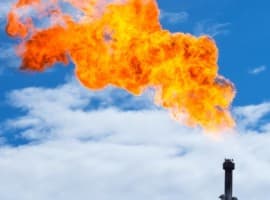
Nigeria has approved 28 companies to buy natural gas that is currently being flared at oil fields, a long-running problem the country has talked about fixing for years and is now trying—again—to turn into something usable.
The permits were issued under the Nigerian Gas Flare Commercialization Program, the upstream regulator said this week. Forty-two companies applied to capture gas from 49 flare sites in the Niger Delta. Fourteen bidders did not meet the requirements and were not approved.
The regulator estimates that between 250 million and 300 million standard cubic feet of gas could be captured and sold if the projects move forward. Officials say the gas could be used for power generation and industrial demand and could attract up to $2 billion in investment. Whether those figures hold will depend on how quickly infrastructure is built and whether operators actually deliver.
Nigeria’s gas losses are well documented. The country produces more gas than oil by reserves, yet still burns off a meaningful share because gathering and transport systems are missing or unreliable. In October, Nigeria produced about 221 billion standard cubic feet of gas. Roughly 7.6% of that was flared, according to regulator data.
The announcement comes days after an explosion disrupted the Escravos–Lagos gas pipeline, one of the most important links in Nigeria’s gas network. The pipeline supplies gas to power plants and industrial users in the southwest and has a capacity of about 2.2 billion cubic feet per day. Any outage on the line immediately raises concerns about the electricity supply.
That incident shows that gas shortages, not demand, are the constraint. Power generation depends heavily on gas, and supply disruptions are common.
Nigeria has framed the flaring program as part of its plan to cut emissions and reach net zero by 2060. In practice, the motivation is simpler. Gas that is burned produces no revenue, no electricity, and no backup when pipelines fail.
The permits are a step on paper. Whether they result in meaningful volumes will depend on execution, something Nigeria’s gas sector has struggled with before.
By Julianne Geiger for Oilprice.com
More Top Reads From Oilprice.com
- Exxon Joins Chevron in Eyeing Lukoil’s Global Fire Sale
- Sanctions Slow Russian and Iranian Crude Flows to China
- Hungary Signs Gas Supply Deal with Azerbaijan