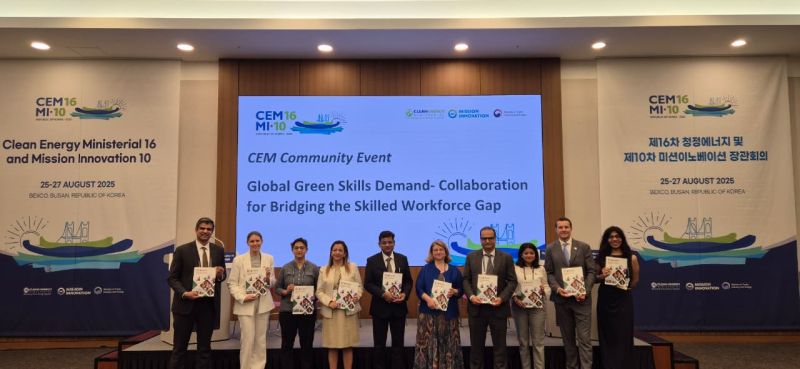
The National Solar Energy Federation of India (NSEFI) convened an international dialogue on “Global Green Skills Demand – Collaboration for Bridging the Skilled Workforce Gap” during the 16th Clean Energy Ministerial (CEM16) in Busan. The session brought together representatives from governments, multilateral institutions, industry leaders, and civil society organizations to address one of the most pressing challenges in the global energy transition—building a skilled, mobile, and inclusive workforce for the clean energy sector.
Discussions during the panel focused on aligning workforce development with advanced clean energy manufacturing, research and development, and automation. Stakeholders also examined the need for interoperable frameworks for training, certification, and labour mobility across borders. Ensuring inclusive strategies that create opportunities for women, youth, and vulnerable communities was highlighted as a critical priority.
Other themes included financing resilient skilling ecosystems in low-income and emerging economies, supporting reskilling initiatives in industrial clusters and coal-dependent regions, and embedding circular economy expertise for recycling and end-of-life management of clean energy infrastructure.
According to sectoral estimates, more than 16.2 million people are currently employed in renewable energy worldwide, a figure projected to exceed 38 million by 2030. The dialogue underscored that this rapid growth demands coordinated global action, harmonized skills frameworks, and people-centred policies.
NSEFI also presented its ongoing initiatives, including the establishment of a Center of Excellence in Clean Energy. The centre aims to deliver employment-ready skills for both blue- and white-collar workers in the renewable sector, reinforcing India’s role in shaping the global green workforce.
Subscribe to get the latest posts sent to your email.