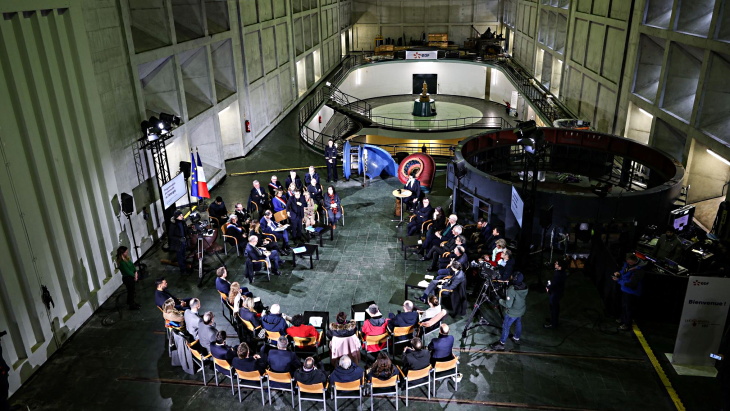
The Multiannual Energy Programme (PPE) is not a piece of legislation, but presents the trajectory to be followed over the next decade in terms of energy policy. It has two main objectives: to reduce the country’s fossil fuel consumption and to ensure a clear, fair and sustainable transition.
The government said the third is the result of extensive consultations initiated in 2022 with members of parliament, industry representatives, and local elected officials. It is based on parliamentary debates from spring 2025, as well as the latest forward-looking scenarios published by transmission system operator RTE in December 2025. The chosen guidelines, it said, take into account the reality of electricity consumption observed in recent years, as well as its strong ambition to electrify energy use by 2030-2035.
The PPE3 aims to increase decarbonised electricity production to between 650 and 693 TWh in 2035, compared with 458 TWh in 2023, while reducing fossil fuel consumption to about 330 TWh in 2035, compared with 900 TWh in 2023. This trajectory, the government said, “will reverse the country’s energy consumption pattern, with 60% of energy being decarbonised by 2030 and 70% by 2035 … The strategy is based on a balanced energy mix combining nuclear and renewable energies”.
The latest PPE sets a nuclear production target of 380-420 TWh per year between 2030 and 2035, compared with the previous 360-400 TWh range, consistent with EDF’s target of 400 TWh.
In February 2022, President Emmanuel Macron announced that the time was right for a nuclear renaissance in France, saying the operation of all existing reactors should be extended without compromising safety and unveiling a proposed programme for six new EPR2 reactors, with an option for a further eight EPR2 reactors to follow.
The PPE3 formalises these ambitions by calling for: extending the lifespan of existing reactors to 50 or even 60 years, subject to safety requirements; the construction of six EPR2 reactors; setting the objective of being able to decide, as early as 2026, on the launch of the construction of eight additional EPR2 reactors; starting construction of a first small modular reactor (SMR) around the beginning of the 2030s; and renewing of the back-end of the nuclear fuel cycle. Notably, the latest PPE formally abandons the previous objective in PPE2 of shutting down 14 reactors, including the two units at the Fessenheim plant.
“Aligned with the National Low-Carbon Strategy, European commitments, and the Paris Agreement, the PPE3 constitutes an ambitious, realistic, and adaptable plan for building a sovereign, decarbonised, and competitive energy system,” the government said.
It noted that the implementation of the PPE3 will generate more than 120,000 additional jobs by 2030, particularly in the nuclear, solar photovoltaic, and offshore wind sectors. It will also help reduce dependence on fossil fuel imports, which currently represent nearly EUR60 billion (USD71 billion) per year.
Industry responses
“EDF, Framatome, and Orano wish to thank the government for sharing its vision and for taking into account the balance of the French electricity system,” Framatome said in a statement. “They welcome the priority given to electrification and the strong support for the sustainability and development of the nuclear sector. These priorities are essential to guaranteeing continuity of production, the safety of facilities, and the creation of skilled and sustainable jobs throughout the country.
“With its capacity to produce competitive, dispatchable, and low-carbon electricity, nuclear power is an essential pillar for the successful electrification of energy uses and the security of the country’s supply. Thanks to the excellence of the nuclear sector, France possesses a sovereign technology that allows it to provide economic sectors and consumers with the cheapest electricity in Europe.”
EDF said it was committed to the PPE3 with the construction programme for six EPR2 nuclear reactors and an option for eight more, extending the operating life of existing nuclear reactors, and revitalising investments in hydropower while maintaining expertise in renewable energy, particularly offshore wind projects.
“EDF teams are mobilised to carry out these projects in compliance with the requirements set in terms of safety, security, quality, deadlines and costs. The implementation of the PPE3 must preserve the coherence of the public framework, an essential condition for the performance and long-term balance of the electricity system. Within this framework, the electrification of energy uses is a central lever for the energy transition, requiring the mobilisation of all public and private stakeholders to replace imported fossil fuels with competitive, sovereign, and low-carbon electricity, to which the EDF Group contributes.”
EDF Chairman and CEO Bernard Fontana added: “The publication of the multi-year energy programme allows EDF to move forward towards its objectives: to provide the French people, today and for future generations, with competitive, sovereign and low-carbon electricity.”
Orano said the opportunities presented by the PPE3 represent significant ongoing and future investments across the entire nuclear fuel cycle.
“The new multi-year energy programme provides the necessary visibility for managing our industrial projects, which contribute to ensuring the production of low-carbon, dispatchable electricity available to our industries in the regions and to our homes,” said Nicolas Maes, CEO of Orano.
Groupement des Industriels Français de l’Energie Nucléaire (Gifen) – the trade association of the French nuclear industry – said the PPE3 “represents a decisive step in giving France the visibility essential for long-term investments, and confirms the crucial role of nuclear power at the heart of the French energy strategy. Nuclear power is a fundamental pillar of French energy sovereignty. By providing low-carbon, safe, and controllable electricity, it addresses climate, energy, and reindustrialisation challenges. By replacing fossil fuels for uses such as transportation and heating, nuclear energy can help accelerate electrification, a prerequisite for decarbonising the economy”.