“A record high in nuclear power output is expected in 2025,” the IEA says. “Technology advances – particularly in small modular reactors (SMRs) – are improving the outlook for nuclear power. As demand surges and the need for reliable, low-emissions baseload electricity increases, nuclear is increasingly seen as a critical part of a secure, affordable and diverse electricity mix.”
The notes that more than 40 countries now include nuclear energy in their strategies and are taking steps to develop new projects. In addition to reactors that are restarting operation, notably in Japan, there is more than 70 GWe of new capacity under construction, one of the highest levels in 30 years. “Innovation, cost control and greater visibility on future cash flows is essential to diversify a sector that has been characterised by high market concentration, including for construction, uranium production and enrichment services,” it says. “Technology companies are supporting the emergence of new business models, with agreements and expressions of interest for 30 GW of SMRs, mainly to power data centres.”
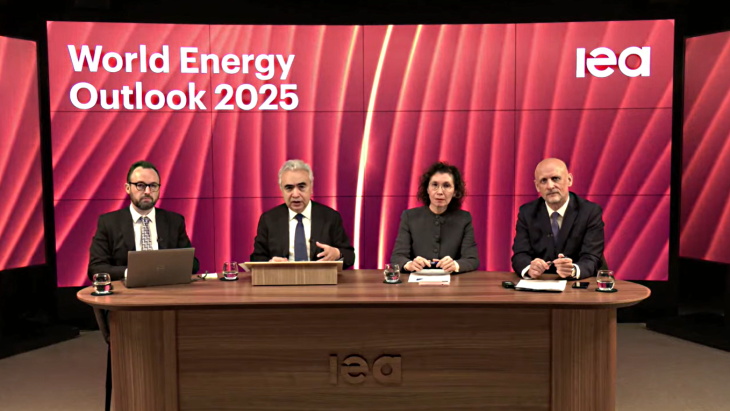
The World Energy Outlook 2025 considers three scenarios. The Stated Policies Scenario (STEPS) provides an outlook based on the latest policy settings, including energy, climate and related industrial policies. The Current Policies Scenario (CPS) considers a snapshot of policies and regulations that are already in place. The Net Zero Emissions by 2050 Scenario (NZE) describes a pathway to reduce global energy-related carbon dioxide (CO2) emissions to net-zero by 2050.
Under the Current Policies Scenario, global nuclear generating capacity increases from 420 GWe in 2024, to 563 GWe in 2023 and reaches 728 GWe in 2050. The IEA says the “current pipeline of projects helps raise deployment in the 2030s to levels not seen since the 1980s”.
“This momentum follows a challenging period marked by delays and cost overruns in several high-profile projects in Europe and the United States. Globally, nuclear power output doubles [to 784 GWe] to 2050 in the STEPS, maintaining a stable 9% share of electricity generation but falling well short of global initiatives to triple capacity,” the report says.
In the Net Zero Emissions by 2050 Scenario, the pace of nuclear capacity additions is expected to slow after the mid-2030s, in line with other low-emissions technologies, as most electricity systems become largely decarbonised by then. As a result, capacity rises to 1,079 GWe.
Investments in nuclear energy have grown by more than 70% over the past five years, according to the IEA. “Spending on nuclear increases in both scenarios as several countries take final investment decisions on large new reactors, pushing the current investment level up 40% to more than USD100 billion per year in the Stated Policies Scenario, and by about 30% to over USD90 billion per year in the CPS.”
The World Energy Outlook notes that several countries have signed a pledge to triple global nuclear power capacity by 2050. “If fully realised, this commitment would increase global nuclear capacity from 413 GW in 2020 to 1,240 GW by mid-century, which would exceed the level in the NZE Scenario by 160 GW.”
It adds: “Achieving this tripling of nuclear capacity would require a significant increase in investment. Annual investment spending would need to rise from over USD70 billion today to a peak of about USD210 billion around 2035 before plateauing at around USD160 billion through the 2040s. Investment would need to be on average 50% higher throughout the 2040s than in the NZE Scenario, resulting in an additional USD900 billion of spending by 2050. This scaling up would be heavily dependent on robust supply chains, skilled labour and long-term policy support.”
Age of Electricity
Electricity is at the heart of modern economies, the IEA says, and electricity demand grows much faster than overall energy use in all scenarios in the latest World Energy Outlook. “Investors are reacting to this trend: spending on electricity supply and end-use electrification already accounts for half of today’s global energy investment. For the moment, electricity accounts for only about 20% of final energy consumption globally, but it is the key source of energy for sectors accounting for over 40% of the global economy and the main source of energy for most households.”
“Analysis in the World Energy Outlook has been highlighting for many years the growing role of electricity in economies around the world. Last year, we said the world was moving quickly into the Age of Electricity – and it’s clear today that it has already arrived,” IEA Executive Director Fatih Birol said.
“In a break from the trend of the past decade, the increase in electricity consumption is no longer limited to emerging and developing economies. Breakneck demand growth from data centres and AI is helping drive up electricity use in advanced economies, too. Global investment in data centres is expected to reach USD580 billion in 2025. Those who say that ‘data is the new oil’ will note that this surpasses the USD540 billion being spent on global oil supply – a striking example of the changing nature of modern economies.”