Summary
- Iran peace talks yield no agreement
- Trump vows to blockade Strait of Hormuz
- Military vessels approaching strait to be viewed as ceasefire breach – Iran’s Guards
(Reuters) – Oil prices jumped back above $100 a barrel on Monday as the U.S. Navy prepared to block ships to and from Iran via the Strait of Hormuz, a move that could restrict Iranian oil exports, after Washington and Tehran failed to reach a deal to end the war.
Get the Latest US Focused Energy News Delivered to You! It’s FREE:
Brent crude futures gained $7.03, or 7.4%, to $102.23 a barrel by 0810 GMT after settling 0.75% lower on Friday. U.S. West Texas Intermediate was up $7.31, or 7.6%, at $103.88 a barrel following a 1.33% loss in the previous session.
“The market is now largely back to conditions before the ceasefire, except now the U.S. will block the remaining up to 2 million barrels per day Iranian linked flows through the Strait of Hormuz as well,” said Saul Kavonic, head of energy research at MST Marquee.
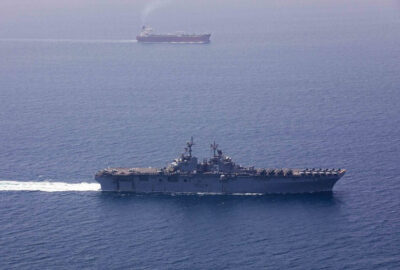
President Donald Trump said on Sunday the U.S. Navy would start blockading the Strait of Hormuz, raising the stakes after marathon talks with Iran failed to reach a deal to end the war, jeopardising a fragile two-week ceasefire.
He added that the price of oil and gasoline may remain high through November’s midterm elections, a rare acknowledgement of the potential political fallout from his decision to attack Iran six weeks ago.
U.S. Central Command said U.S. forces would begin implementing the blockade of all maritime traffic entering and exiting Iranian ports at 10 a.m. ET (1400 GMT) on Monday.
“Not only does this restrain exports from Persian Gulf oil producers, but it will also restrict Iran’s ability to export oil and will exacerbate the supply disruptions the market is experiencing,” ANZ analysts Brian Martin and Daniel Hynes said in a note.
IG market analyst Tony Sycamore said the move would effectively choke off the flow of Iranian oil, forcing Tehran’s allies and customers to apply the necessary pressure to get the waterway reopened.
Iran’s Revolutionary Guards said on Sunday that any military vessels attempting to approach the Strait of Hormuz would be considered a violation of the two-week U.S. ceasefire and be dealt with harshly and decisively.
Despite the stalemate, three supertankers fully laden with oil passed through the Strait of Hormuz on Saturday, shipping data showed. They appeared to be the first vessels to exit the Gulf since the ceasefire deal was struck last week.
No other ships were spotted in the strait on Monday except for one Iran-flagged vessel anchored there, shipping data on LSEG showed.
On Sunday, Saudi Arabia said it has restored full oil pumping capacity through the East-West pipeline to about 7 million barrels per day, days after providing an assessment of damage to its energy sector from attacks during the Iran conflict.

Supertankers pass Strait of Hormuz amid US-Iran ceasefire
Reporting by Florence Tan; Editing by Chris Reese and Jamie Freed
Share This:
More News Articles