Tuesday, 1 April 2025
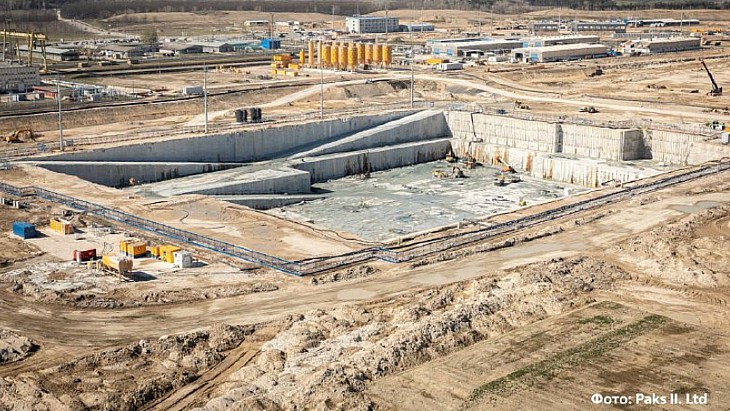
In December excavation of soil to a depth of 23 metres was under way with more than half of the 75,000 required piles drilled into the ground during soil consolidation works. The first large-scale nuclear power plant equipment – the core catcher – was delivered to the site in August. Also known as a melt trap, the core catcher is a container in the form of a cone made of thermally resistant steel which in the unlikely event of an emergency will securely hold the melt of the core and not allow radioactive substances to leave the containment of the reactor.
Hungary’s Foreign Affairs and Trade Minister Péter Szijjártó said in December he expected first concrete to be poured in the first quarter of 2025. But according to a report by Russia’s Tass news agency that timeline has “had to be adjusted following soil fracture somewhere inside the pit. Rosatom said the incident had no effect on the foundation pit’s technical specifications, but work in that area was suspended in accordance with the Hungarian watchdog’s decision” and the authority “requested a report on additional checks and measures taken in connection with the soil fracture, but has not yet issued permission for first concreting. The permission is expected soon”.
In February Paks II Ltd Chairman and CEO Gergely Jákli, together with Andrea Beatrix Kádár, Chairman of the Hungarian Atomic Energy Authority, gave evidence to the Hungarian Parliament’s Sustainable Development Committee.
Paks II’s report on the session says that they explained that the “working pit did not collapse, but two corners on the prominent ‘peninsula’ in the southern section broke off, affecting half a percent of the more than 700-metre perimeter wall”. That section is around 400 metres from Paks’ unit 4 “and the incident did not affect the operating power plant at all”. The condition of the wall section in question and its surroundings is continuously monitored, said Jákli.
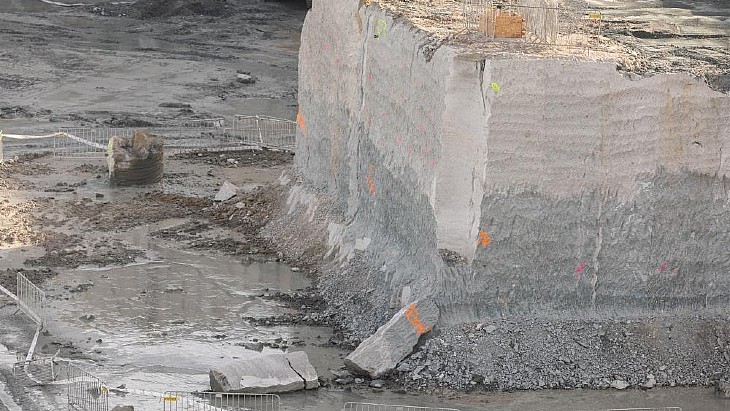
A picture of the affected section, posted as part of the report on the parliamentary session (Image: Paks II Ltd)
He said that following the corner detachment on 30 January, work in the area immediately stopped and the area was fenced off and an investigation begun into what had happened. He emphasised that the company “was under no time pressure regarding the investigation, and the event will be fully investigated. In the nuclear industry preventive measures must be taken and we have done that”, he added.
The February update also added that “groundwater and the technological water generated from the construction activities are present in controlled conditions thanks to the cut-off wall, in an amount corresponding to the size of the working pit and in a smaller amount compared with the design parameters”. He added “safety continues to be the first priority in the decisions of Paks II Ltd”.
The Paks II project
The Paks plant, 100 kilometres south of Budapest, currently comprises four Russian-supplied VVER-440 pressurised water reactors, which started up between 1982 and 1987. An inter-governmental agreement was signed in early 2014 for Russian enterprises and their international sub-contractors to supply two VVER-1200 reactors at Paks as well as a Russian state loan of up to EUR10.0 billion (USD10.5 billion) to finance 80% of the project.
The construction licence application was submitted in July 2020, the construction licence was issued in August 2022 and a construction timetable agreed in 2023, including first concrete this year, with a target to connect the new units to the grid at the beginning of the 2030s.