Monday, 27 January 2025
_12276.jpg)
The aim of this partnership is to structure the industrialisation of the XAMR, integrating the key phases of the project: design, prototyping, first-of-a-kind (FOAK) manufacturing and mass production. To meet these challenges, Naarea and Phoenix Manufacture will harness technologies such as 3D printing and envisage creating a joint plant including specially designed reprocessing facilities.
Phoenix Manufacture – based in Niort, western France – specialises in industrial precision engineering and the design and manufacturing of mechanical systems for the military, nuclear, petroleum, aerospace and robotics sectors.
The partnership between Naarea and Phoenix Manufacture aims to implement industrial solutions for the various phases of development of the XAMR, in particular for prototyping, FOAK production and mass production.
The collaboration is based on five main phases extending until 2032: the preliminary phase, including validation of raw materials and the manufacturability of parts designed by Naarea for additive manufacturing; prototyping of the components of the XAMR microreactor; series production, including providing the necessary parts for the FOAK and mass production; scaling up production capacity, including studying the creation of a joint production facility for XAMR components, pooling of resources and mutual skill development; and evaluating solutions for recycling and recovering waste material resulting from production and the recycling of used components.
“We have chosen to rely on the expertise and skill of Phoenix Manufacture, a French company that will contribute to the design of an XAMR microreactor made in France,” said Naarea founder and CEO Jean-Luc Alexandre. “Incorporating additive manufacturing represents a major asset for us: it will allow us to produce parts with consistent quality controlled in situ at each step of the manufacturing process. Additive manufacturing also makes it possible to lower production costs, reduce assembly needs and meet the highest standards in terms of safety and security, which remains our absolute priority.”
Phoenix Manufacture CEO and co-founder Marco Calcamuggi added: “We are proud of this strategic partnership with NAAREA, since additive manufacturing is at the heart of our vision for French reindustrialisation. We firmly believe that this disruptive technology is profoundly transforming all industries, in particular the nuclear sector.”
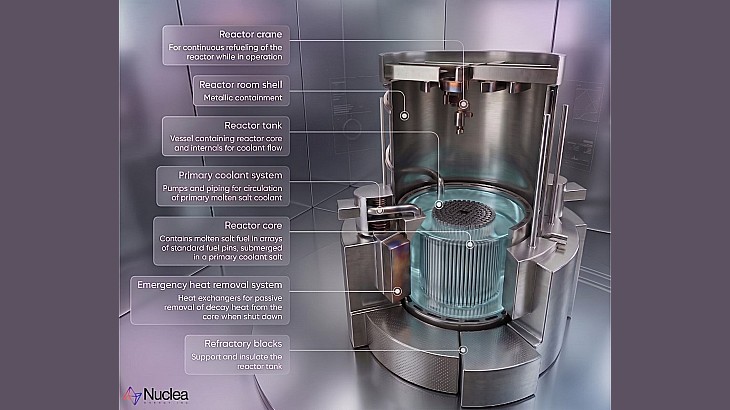
Naarea – formally established in November 2021 – says its ultra-compact molten salt fast neutron reactor will use “the untapped potential of used radioactive materials, and thorium, unused mining waste”. Once it develops the eXtra Advanced Nuclear Reactor (XAMR) design, the company intends to target applications in areas such as transportation, agriculture and smart buildings.
Naarea says that, because of the compact size of its reactor and because there is no need for it to be grid-connected, the XAMR can “be deployed as close as possible to regions, to match energy demand as closely as possible and allow the control of security of supply, at the service of industries and communities”. It expects the first units of XAMR – which can generate 80 MWt/40 MWe – to be produced by 2030.
Earlier this month, Naarea announced a strategic partnership with advanced energy management platform QGEMS aimed at integrating QGEMS’ technology to optimise Naarea’s energy production and distribution, set to commence in 2025. In addition, Naarea said using QGEMS’ advanced energy management system would extend the applications of its reactor to data and AI centres, commercial properties, industrial facilities and remote territories.