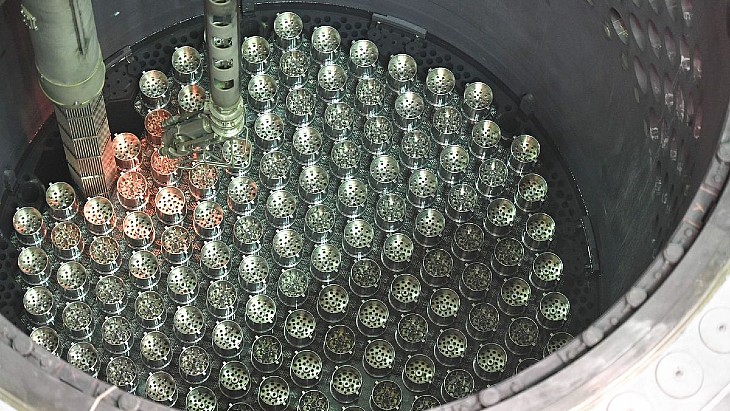
The fuel assemblies with experimental fuel elements have undergone a standard cycle of nuclear fuel operation for Russian VVER-1000 reactors – three fuel campaigns of 18 months each.
Accident tolerant fuel (ATF) is a term used to describe new technologies that enhance the safety and performance of nuclear fuel. ATF may incorporate the use of new materials and designs for cladding and fuel pellets.
According to Russia’s state nuclear corporation Rosatom, in the event of coolant loss and disruption of heat removal in the reactor core, “ATF should maintain its integrity for a sufficiently long period of time without the occurrence of a steam-zirconium reaction that would lead to hydrogen release”.
In 2021 three fuel assemblies of the TVS-2M design were loaded into the reactor core, each with 12 of the new fuel elements. Six were manufactured using 42KhNM chromium-nickel alloy as a structural material and six were made with chromium-coated zirconium alloy cladding.
Rostov NPP Director Andrey Salnikov said: “The fuel assemblies have completed three full fuel cycles as planned. We now need to prepare a fairly extensive package of documents for Rostekhnadzor (Russia’s nuclear regulator), after which the fuel will be transferred for post-irradiation studies to the Research Institute of Atomic Reactors in Dimitrovgrad.”
Alexander Ugryumov, Senior Vice President for Scientific and Technical Activities at Rosatom’s fuel division TVEL, said: “Considering all factors – economics, technology, regulations, and procedures – the optimal option for industrial implementation is cladding made of a classic zirconium alloy with a chromium coating. This is the solution adopted by all leading global nuclear fuel manufacturers. But for Russia, where the strategy of closing the nuclear fuel cycle is being implemented, the ATF development programme has yielded another important result. The properties of the chromium-plated surface make it possible to eliminate a number of operations during the fabrication of nuclear fuel for VVER reactors, which still rely on manual labour. And unmanned fabrication is a prerequisite for the industrial production of fuel with reprocessed uranium and plutonium.”
The final stage for qualification of the ATF fuel will be the loading of fuel assemblies containing 312 of the new fuel elements. A production site for applying chromium coatings to shells made of traditional zirconium alloy has been created at the Chepetsky Mechanical Plant in Glazov.