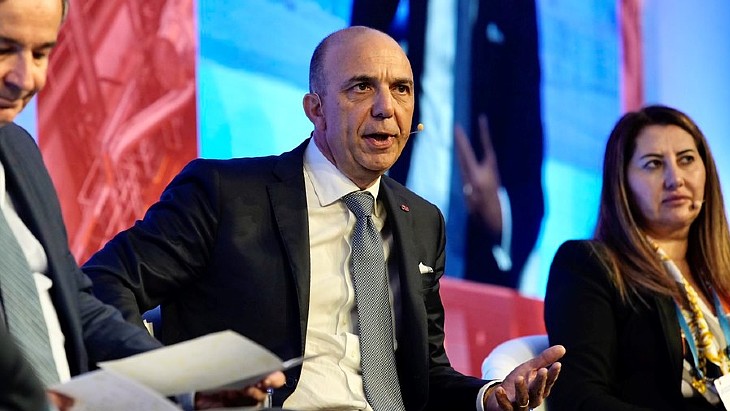
In an interview for the World Nuclear News podcast Aubarbier, Deputy CEO of French multinational engineering giant Assystem, also covered the progress of the French EPR2 programme, how regulation differs in different countries, and the company’s work in the fusion sector.
You can listen to the full interview above, or via all good podcast platforms. Here is an edited selection of key quotes.
On funding for new nuclear:
The funding of a new nuclear programme is like buying an apartment. If you are seen as a good party, and your ability to pay back the money is high, the risk factor taken into account by the bank will mean you get a better interest rate than others. The sum of interest depends on your interest rate, and also the duration of your loan. Everybody knows this from buying an apartment – if you borrow money over five years it will cost you less than borrowing it over 15 years.
For a nuclear programme, it is exactly the same. If you have a proven technology with a good track record, your risk factor is lower, and you will borrow money at a lower interest rate. If it is backed by the government, it means that the ability to reimburse is even better, and the interest rate will be even lower. Then, if your project lasts 200 months, or if your project lasts 60 months, obviously the amount of interest paid will not be the same at the end, and it means that the price per megawatt-hour will not be the same. So the assessment is very, very easy to do.
We have to go for proven technologies, with good track records and construction processes. And then we will find the funding. The funding depends on the ability to find offtakers, and the offtaker will be ok to go for nuclear power as soon as the megawatt-hour cost is competitive – and to be competitive, we need to borrow money at a low interest rate, and for a short time.
What is the target timeline for building a new nuclear plant?
If you go for a proven technology and then you are efficient in the licensing process, it means that from the day you contract with a technology provider, to the day you start the construction, if you’re efficient, it’s about 36 months.
Then for the construction time, the optimum duration is probably around 60 months for the best ones, while others reach 80 or 90 months. So when you consider the overall timeframe, from the day you contract to the day you connect to the grid, it should be something looking like 100 to 140 months (that’s a range of just over eight years to just under 12 years).
What is the target for France’s EPR2 programme?
The target for the construction phase is about 70-75 months. It is an ambitious target. But it is necessary. If the tripling of nuclear energy capacity by 2050 is to be achieved, there needs to be financing. And to find the financing we have to show that nuclear projects are secure, in terms of delivery of the projects. Then we will have a low interest rate. And if we have a construction timeframe of 60-90 months, we will be able to reach an acceptable price per MWh.
Does this apply across different countries?
We are currently involved with SMR and/or large power unit planning in roughly speaking 13/14 different new nuclear programmes, at different stages of the programmes. Some are feasibility studies, meaning that some of them will probably not happen. Some of the others will happen and the key factor, the key success factor is definitely the ability to fund the project. Everywhere, whether the country is a rich country, or a less rich country, the key success factor is always the same – are we able to fund the project? And to be able to fund the project we need to have an offtaker. And to have an offtaker we need to have an acceptable MWh price and to have an acceptable MWh price we need to have a low interest rate and construct fast. The assessment is simple. The challenge is very simple. I think it is important for the nuclear industry to accept that that statement is the key. If we are not able to find the correct answer then the development of nuclear in the coming decades will not be the one which is being forecast now.
Are there positive signs on international regulatory convergence?
Most newcomer countries in nuclear make the choice to use either European or US standards and the requirements, expectations and safety expectations are high everywhere. Regulatory bodies are not exactly the same everywhere, as we all know in nuclear, but when you consider the standards, there are fewer and fewer discrepancies. The big difference we see is between countries finding appropriate paths for the licensing and permitting. We see that Western countries are a bit tied in with existing regulation processes with low ability to change things and to adapt. It’s the reality for all big infrastructure projects. Regulation has evolved in a way that it has become, to some extent, an impediment to the economic viability of some projects. There is work ongoing, for example in the UK, to simplify regulation for big infrastructure projects. It is the case in France as well, but I would say that most of the newcomer countries are more agile in the way they can adapt to those big infrastructure projects. That is where the big difference is. But on standards and safety regulation there is less and less difference and there is increasing homogeneity between different countries.
Assystem’s fusion work
We have been involved in the ITER (multinational fusion) project for 15 years now and we are at the end of that phase, for the development of all the nuclear buildings, including the tokamak building, which we delivered on time in 2020. We have on-going work on construction management of the machine, with a consortium, which will be delivered on the existing time frame as scheduled. We also participate with a number of fusion initiatives, start-ups, in France and in the UK, for example. We are still at the research phase of fusion, we are far away from the time where it will be possible to deliver electricity on the grid with fusion reactors. But in the meantime, some of the nuclear fusion startups we work with are working on fusion as a way to develop new technologies – and the outcome of developing technologies will be in the coming years, and that will enable the work towards delivering energy from fusion, which will probably be closer to the end of the century than the middle of the century.
What advice would you give to a young person considering a career in nuclear?
My advice to any student in any country would be to find something where they have fun. And if you have studied physics, science or engineering, nuclear is a dream world to work in. I would also say that nuclear also meets the challenges of energy sovereignty and the need to fight against climate change. So working in nuclear – you have fun and you are helping build the future.
You can listen and subscribe on all major podcast platforms:
Episode credit: Presenter Alex Hunt. Co-produced and mixed by Pixelkisser Production
Email newsletter:
Contact info:
alex.hunt@world-nuclear.org
Cover Picture: Assystem’s Stéphane Aubarbier at World Nuclear Symposium 2024