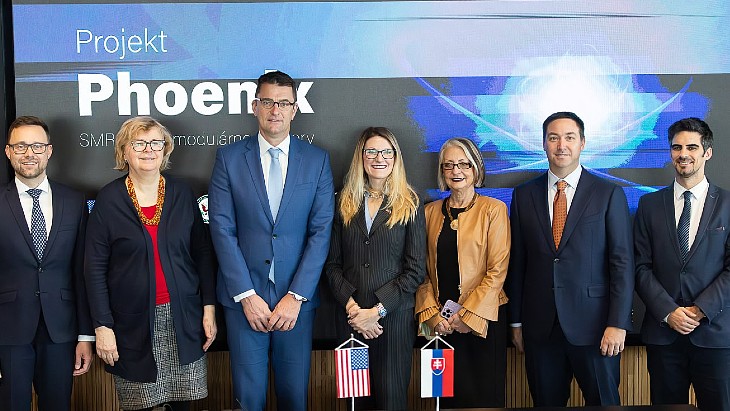
The Project Phoenix study, carried out by Sargent & Lundy with Slovakia’s Ministry of Economy and nuclear energy operator Slovenské elektrárne, aimed to assess the country’s readiness and potential to host small modular reactors (SMRs), with a focus on four specific locations – Bohunice, Mochovce, Vojany, and US Steel Košice.
According to Slovenské elektrárne the evaluation used International Atomic Energy Agency recommendations including external risks, geological conditions, environmental and safety factors and site suitability. As well as the country’s general suitability, the study said that all four sites met the baseline criteria for SMR deployment.
Joshua Best, senior manager at company Sargent & Lundy, said: “The report affirms that Slovakia is strategically situated to deploy SMRs, with several mature, safe, and secure SMR technologies available that align with the country’s needs and goals. All candidate sites assessed are viable, and Slovakia is primed to take the next steps should they choose to proceed.”
The next steps are expected to be the development of a regulatory framework, detailed site investigations and public information and consultation. Project Phoenix was launched in 2022 with the aim of supporting energy security and climate goals by creating pathways for coal-to-SMR power plant conversions while retaining local jobs through workforce retraining.
Szabolcs Hodosy, First State Secretary of the Ministry of Economy of the Slovak Republic, said: “It is crucial that such decisions are based on expert analyses, international safety standards, and transparent dialogue with the public. I am glad that a new area of nuclear energy is taking shape in Slovakia, where we can make use of our many years of experience and thus also outline a clear direction for future generations of ‘nuclear experts’. Nuclear energy is experiencing its renaissance, and we must take timely steps – both in education and in preparing infrastructure, as well as in promoting support for nuclear energy across all platforms – so that we can then share the benefits of nuclear energy production at both the national and regional levels.”
Branislav Strýček, Chairman and CEO of Slovenské elektrárne, said: “Small modular reactors represent a strategic opportunity for Slovakia. They can strengthen our energy security, support decarbonisation, and bring new investment to the regions. The study confirms that we not only have suitable sites, but also the technical know-how and experience to build on.”
US Deputy Chief of Mission in the Slovak Republic, Heather Rogers, said: “Project Phoenix demonstrates Slovakia’s robust nuclear energy experience, infrastructure, regulatory framework, and industrial base provide a strong platform for early deployment of small modular reactor technologies under the highest international safety and security standards. We are delighted to support Slovakia’s efforts to strengthen energy resilience and shared prosperity and look forward to continued collaboration.”
Slovenské elektrárne says that SMRs could be operational in the country from as early as 2035. Slovakia currently has five nuclear reactors generating about half its electricity, with one more reactor under construction. The first two, at Bohunice, went into commercial operation in 1984 and 1985, respectively, while Mochovce 1 and 2 were connected to the grid in 1998 and 1999, respectively. Construction of Mochovce 3 and 4 began in 1986 but was halted in 1992. It was later restarted and Mochovce 3 entered service in 2023, with work continuing on Mochovce 4.
The Slovak government also has plans for a new large-scale unit. It officially approved plans in May 2024 for a 1.2 GWe unit near the existing Bohunice nuclear power plant. In September 2025 ministers approved wording for a proposed intergovernmental agreement with the USA “on the construction of a new nuclear unit … which will be state-owned and will have an output of more than 1,000 MW” and Slovakia’s Prime Minister Robert Fico is meeting US President Donald Trump this weekend and set to sign the agreement, according to multiple media reports, including .