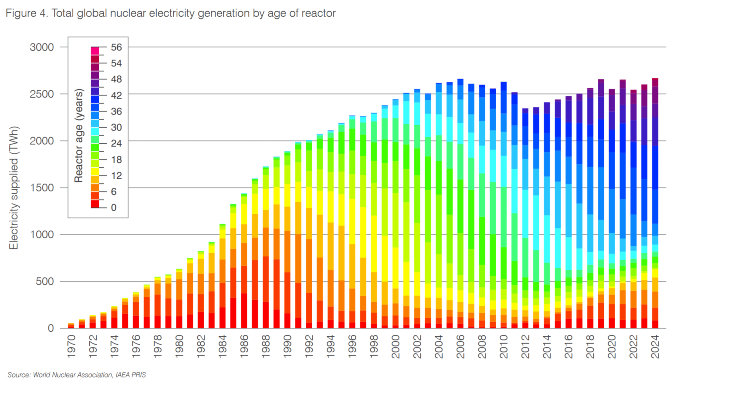
The latest edition of the yearly report, produced by World Nuclear Association, also recorded that the average capacity factor increased to 83% – the capacity factor is how much electricity is produced as a percentage of what could be produced if a power plant was operating at full power non-stop for the entire year.
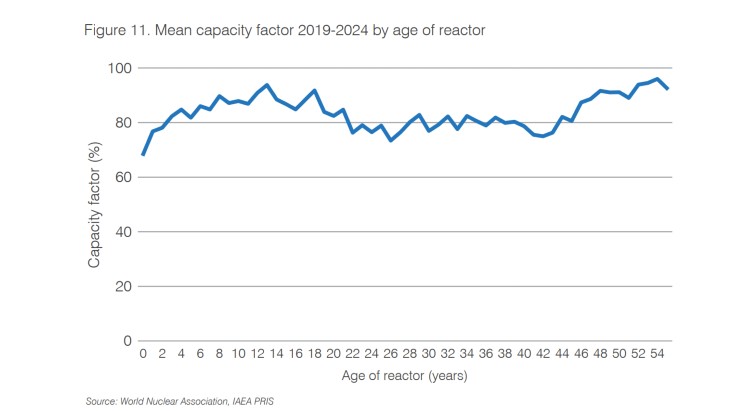
One of the findings of World Nuclear Performance Report 2025 was that there is no decline in performance of reactors as they age, with more than 60% of reactors achieving a capacity factor of more than 80%.
The report says that the increase in global nuclear generation over the past decade is primarily down to Asia, which accounts for 56 of the 68 reactors commissioned. And of the 70 reactors currently under construction, 59 are located in the region.
Director General of World Nuclear Association Sama Bilbao y León said: “The new record electricity generation from nuclear energy in 2024 is a testament to the industry. To meet our global energy and climate goals, it is a record that needs to be bettered again and again, every year, by increasingly larger amounts.
“The challenge ahead is immense, but so is the opportunity. With the backing of bold global industry leaders, forward-thinking governments, and an increasingly engaged public, the path to tripling nuclear capacity is not only achievable, it is necessary. This is our chance to build a cleaner, more secure energy future for everyone everywhere, powered by reliable, low-carbon nuclear energy.”
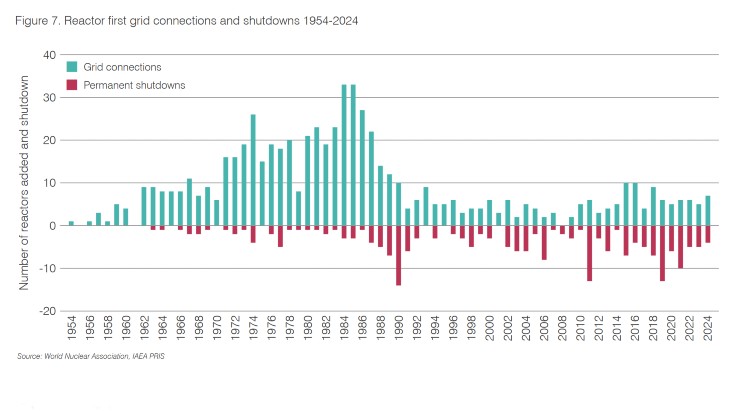
During 2024 seven reactors were connected to the grid – Zhangzhou 1 in China, Vogtle 4 in the USA, Shidaowan Guohe One in China, Kakrapar 4 in India, Flamanville 3 in France, Fangchenggang 4 in China and Barakah 4 in the UAE.
Construction began on nine more during 2024 – Chashma 5 in Pakistan, El Dabaa 4 in Egypt, Leningrad II-3 in Russia, and in China, Lianjiang 2, Ningde 5, Shidaowan 1, Xudabao 2 and Zhangzhou units 3 and 4.
Four reactors were permanently shut down in 2024. These were Kursk 2 in Russia, an RBMK light water graphite reactor, Pickering 1 and 4 PHWRs in Canada, which had operated for 53 and 51 years respectively, and Maanshan 2, a 41-year-old pressurised water reactor that was closed as part of the Taiwanese government phase-out policy.
Report author, Jonathan Cobb, senior programme lead, climate, at World Nuclear Association, told the World Nuclear News podcast that he expects to see the new record broken again in the next years.
“As the reactors currently under construction are grid-connected over the next five to six years, we should see global nuclear capacity and total nuclear generation continuing to rise. There may be some closures of older plants, but our analysis has shown that for the current reactor fleet, including those reactors that have operated for at least 50 years, there is no decline in reactor performance related to age … indeed, in the US, we are seeing some reactors that recently shut being reopened,” he said.
Listen to the full