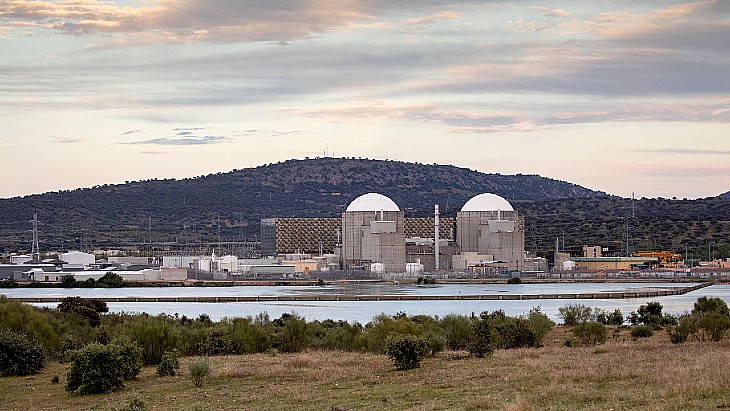
On 30 October, the board of Centrales Nucleares Almaraz-Trillo (CNAT) officially requested a three-year extension to the operating licence for Almaraz plant’s units I and II. The decision, taken at an extraordinary meeting of the board of directors and the general assembly of shareholders, seeks to extend the life of the two units to 2030. They are currently scheduled to be shut down in 2027 as part of Spain’s 2019 nuclear phase-out policy.
The Nuclear Safety Council (CSN) said it received a request on 17 November from the Ministry for Ecological Transition and the Demographic Challenge for a mandatory report on the application to modify the operating licence of the Almaraz plant. The CSN said it “will respond to the request in accordance with current regulations and procedures”.
Once the regulator approves the required report associated with the application, it will be sent to the ministry. With this information, the ministry will be able to make an informed decision regarding the continued operation of the plant.
The law establishing the CSN stipulates that the regulatory body is responsible for issuing reports to the Ministry for Ecological Transition and the Demographic Challenge regarding nuclear safety, radiological protection, and physical security, prior to any decisions the ministry makes concerning the granting of authorisations for nuclear facilities. These reports, which are mandatory, are also binding – in the case of a negative assessment – or establish the necessary limits and conditions.
The Regulation on Nuclear and Radioactive Installations stipulates that the CSN must submit its report to the ministry “at least two months before the expiry date of the current authorisation”. This expiry date corresponds to 1 November 2027 and 31 October 2028, for Almaraz units I and II, respectively.
In June 2020, the CSN approved the operation of Almaraz until June 2030, as licence renewals are for 10 years. However, given the agreed-upon closure schedule, it was decided to extend operations only until October 2027 for Almaraz unit I and one year later for unit II.
Spain’s seven operating nuclear power reactors – Almaraz I and II, Ascó I and II, Cofrentes, Trillo and Vandellós II – generate about 20% of its electricity. Under the country’s nuclear phase-out plans, agreed in 2019, four reactors are scheduled to close by the end of 2030 – including the two Almaraz ones – while the remaining three reactors will shut by 2035.
In February the Spanish nuclear industry called for a rethink of the plans with a manifesto – signed by 32 companies, including Empresarios Agrupados-GHESA (EAG), Framatome, GDES, GE Vernova, IDOM and Westinghouse – saying: “We urge the initiation of a dialogue and renegotiation of the 2019 agreement on the phased shutdown of nuclear power plants. This agreement was made under an industrial, geopolitical, social and economic context that is vastly different from today’s reality. “Our industrial network must not see its competitiveness reduced due to the decision to shut down nuclear power plants starting in 2027, beginning with the Almaraz nuclear power plant, without first securing a viable alternative involving all CO2-free energy sources.”
The Almaraz plant currently supplies more than 7% of the electricity consumed in Spain, equivalent to 4 million homes, and employs about 4,000 people. Almaraz units I and II are pressurised water reactors with a net capacity of 1011 MWe and 1006 MWe, respectively. Unit I entered commercial operation in 1983 with unit II following the next year. The plant is owned by Iberdrola (53%), Endesa (36%), and Naturgy (11%).
CNAT said Almaraz meets all the requirements of the Periodic Safety Review approved by the CSN in 2020 and valid until 2030. It added that with “an annual investment of EUR50 million (USD58 million) for the improvement, upgrading, and modernisation of its equipment, the Almaraz nuclear power plant is in optimal technical condition to continue operating” and cited the example of its “sister plant, North Anna Nuclear Power Plant” in the USA which has been given permission to operate for up to 80 years.