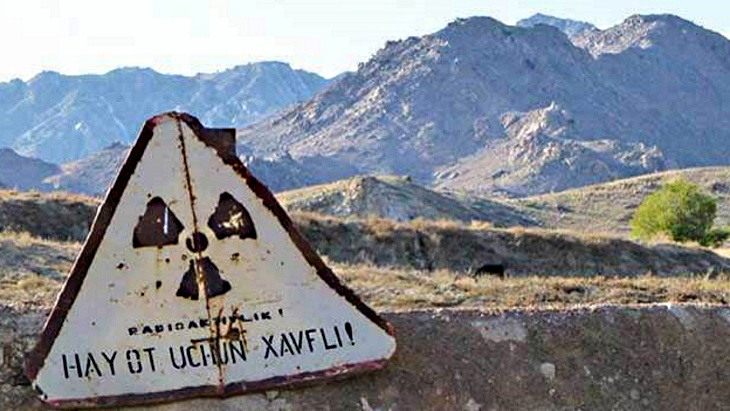
Central Asia served as an important source of uranium for the former Soviet Union. Uranium was mined for more than 50 years and uranium ore was also imported from other countries for processing, and large amounts of radioactively contaminated material were placed in mining waste dumps and tailing sites. Most of the mines were closed by 1995 but very little remediation was done before or after the closure of the mining and milling operations. The contaminated material can pose a threat to the environment and the health of the population. The hazards include the possible pollution of ground and surface water in a key agricultural centre of the region.
The IAEA Coordination Group for Uranium Legacy Sites (CGULS) supports countries to safely manage these sites and the residues of radioactive and toxic contaminants to protect people and the environment. Since 2012, CGULS has supported Central Asian countries with practical guidance on remediation strategies, expert missions to guide progress in remediation efforts, and assisted in capacity building and developing legal and regulatory frameworks for remediating legacy sites.
In 2017, the Strategic Master Plan for Environmental Remediation of Uranium Legacy Sites in Central Asia, which focuses on Kyrgyzstan, Tajikistan and Uzbekistan, was adopted by the IAEA, the European Commission, the European Bank for Reconstruction and Development (EBRD) and the Commonwealth of Independent States Economic Council, as well as the governments of Kyrgyzstan, Tajikistan and Uzbekistan, to establish a strategy and concrete mechanisms to remediate the sites safely and sustainably. The plan – published in May 2018 – identifies seven former uranium production sites in the region as the highest priority: Mailuu-Suu, Min-Kush and Shekaftar in Kyrgyzstan; Degmay and Istikol in Tajikistan; and, Charkesar and Yangiabad in Uzbekistan. The total cost of remediating the seven sites was estimated at around EUR85 million (USD99 million). A revised Strategic Master Plan (SMP) was signed in September 2021.
The was presented in Tashkent, Uzbekistan, in October 2025, and will guide the future activities of the IAEA, international organisations and collaborating countries, focusing on monitoring, maintenance, record keeping and continuous stakeholder engagement towards the safe and beneficial use of the remediated land.
“The new plan, an extension of our collaboration since 2017, focuses on enhancing the regulatory, technical, financial and human resources for the long term management of the remediated sites, according to IAEA safety standards,” said Hildegarde Vandenhove, Director of the IAEA Division of Radiation, Transport and Waste Safety.
“The main objective of the SMP is to demonstrate a sustainable and shared approach to remediation of uranium legacy sites in Central Asia to the international community by collating information on the ongoing projects, required actions and funds,” the IAEA said. “This helps avoid duplication of effort, demonstrates progress, and raises awareness of the funding gap which requires further solidarity by the international community.”
The total cost estimate of the ERA Remediation Programme currently amounts to EUR113 million, which includes remediation costs, Project Management Unit Services cost, contingencies and other programme costs, according to the new Strategic Master Plan. It says this number is based on final or current contract values, or best cost estimates available.
Since 2017, four out of the seven high priority sites have been remediated – two in Kyrgyzstan and two in Uzbekistan – allowing local communities to use the land safely. Work continues at a fifth site in Kyrgyzstan, one of the largest and most complex, with remediation expected to continue until 2032. In Tajikistan, one site has been partially remediated and another remains to initiate remediation.
As well as ensuring the high priority sites are managed and reused safely, the new plan encompasses lower priority sites for remediation – sites that present lower risks in terms of environmental, social and economic considerations, and were not remediated under the previous plan.
“For the lower priority uranium legacy sites EUR21.4 million funding has been approved by the Russian Federation, for the remediation of Kadji-Say (other objects), Tuya-Moyun and Kyzyl-Djar under the bilateral agreement with the Kyrgyz Republic, and EUR15.6 million for the remediation of Adrasman and Processing facility No.3 of Taboshar district under the bilateral agreement with the Republic of Tajikistan,” the SMP says.
“I am firmly convinced that the work of the IAEA Coordination Group for Uranium Legacy Sites stands as a vivid example of how the collective efforts of the international community, united by a shared goal - the protection of people and the environment – can yield tangible and lasting results,” said Sardorbek Yakubekov, Deputy Chairman of the Industrial, Radiation and Nuclear Safety Committee of Uzbekistan, who opened the signing event.