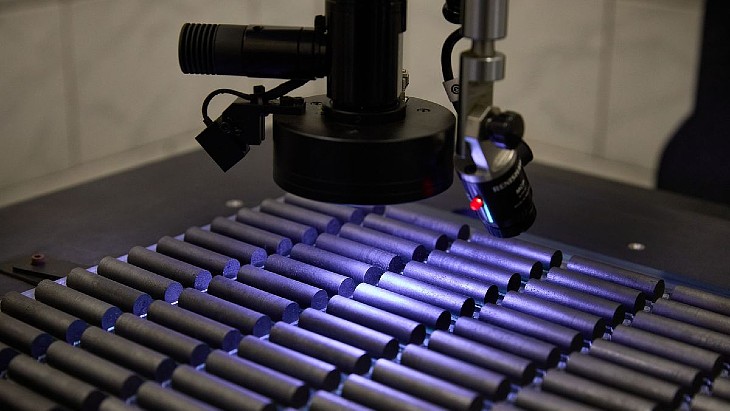
Before the reactor tests the high-temperature gas-cooled reactor (HTGR) fuel – graphite cylinders with uniformly distributed spherical microfuel elements – was irradiated in research reactors under standard conditions for this type of fuel – at temperatures between 1,000°C and 1,200°C to various burnup levels.
“Using specially designed irradiation devices, the pre-irradiated fuel compacts successfully passed tests for over 500 hours at a temperature of 1,600°C. Furthermore, HTGR fuel samples with a burnup of 8% h.a. were tested under even more extreme conditions: the fuel compacts were irradiated at a temperature of approximately 1,700°C for over 380 hours,” Rosatom said.
Fyodor Grigoryev, the project supervisor for Rosenergoatom, said: “The reactor experiments and comprehensive post-irradiation studies conducted by the Scientific Division’s specialists in 2025 complement the accumulated experimental data obtained since 2021 as part of the comprehensive programme for the computational and experimental validation of HTGR fuel. Based on the results of reactor tests and post-irradiation studies, more than 20 HTGR fuel samples were obtained, achieving burnup from 3% to 13%. We can now confidently confirm the maximum design limits of the HTGR reactor facility (in terms of the operation of domestically produced microspherical fuel) established in the design.”
In 2026 Rosatom specialists plan to move on to reactor testing of prototype fuel samples for the HTGR reactor, “manufactured by specialists from JSC Research Institute Scientific and Production Association LUCHon an import-independent pilot production line”. The project is aimed at developing HTGR nuclear power plants as part of moves to create domestic technologies for large-scale production and consumption of hydrogen and hydrogen-containing products.
According to the World Nuclear Association’s , HTGR fuel comes “in the form of TRISO (TRI-structural ISOtropic) particles less than a millimetre in diameter. Each has a kernel of uranium oxycarbide, with the uranium enriched up to 17% U-235. This is surrounded by layers of carbon and silicon carbide, giving a containment for fission products which is stable to 1600°C or more. These particles may be arranged: in blocks as hexagonal ‘prisms’ of graphite, or in billiard ball-sized pebbles of graphite encased in silicon carbide”.