Wednesday, 27 November 2024
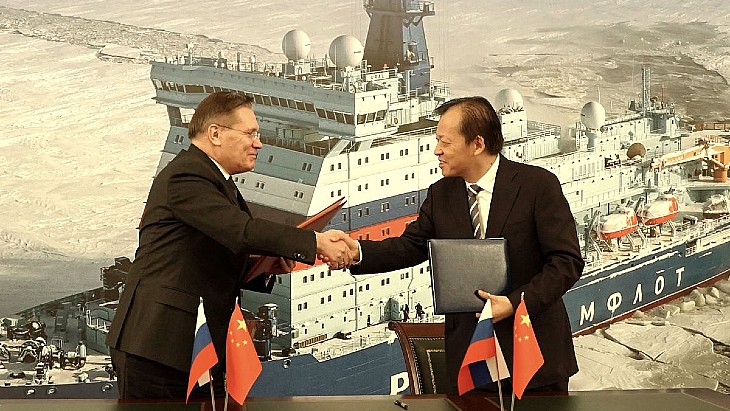
The subcommission, of the Russian-Chinese Commission for the Preparation of Regular Meetings of Heads of Government, was held in St Petersburg. The key areas of focus include shipping safety, planning and ensuring growth of cargo traffic along the Northern Sea Route, promoting the development of logistics routes, exchanging information on ice conditions, meteorological and other conditions.
It follows the agreement of intent signed in June by Chinese businesses and Rosatom to create a joint venture for the construction of ships and a year-round container line between Chinese and Russian ports. The subcommittee talks were led by Rosatom Director General Alexey Likhachev and Chinese Transport Minister Liu Wei.
Likhachev said: “Despite the fact that we are holding the first meeting of the subcommittee, we have already recorded a number of specific agreements between our countries on the safety of navigation. We are developing constructive interaction on other important issues. I believe that we have laid a solid foundation for further work.”
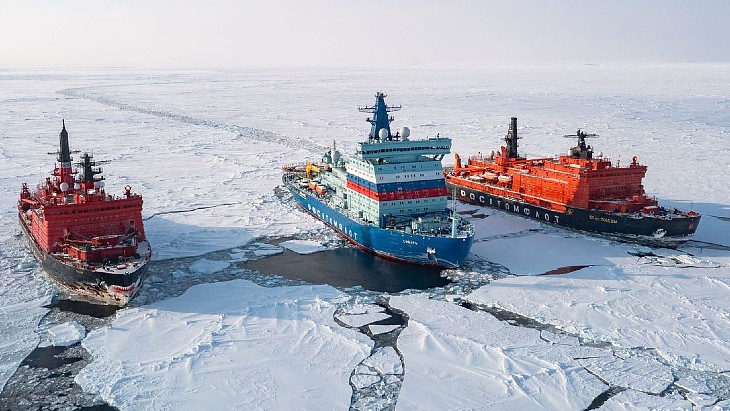
Development of the Northern Sea Route is a strategic priority for the Russian government, with a large-scale construction programme involving nuclear-powered ice breakers taking place to allow expansion of trade off the northern coast of Russia. The 5600-kilometre route runs from St Petersburg and Kaliningrad to Vladivostock. Russia says the distance from Murmansk to Japanese ports is halved by using the Northern Sea Route rather than the Suez Canal, with the duration cut from about 37 to 18 days.
 (Image: Rosatom)
Traffic along the route has gown nearly tenfold over the past decade and preliminary results for this year show transit reaching 3.09 million tonnes, up from 2.127 million tonnes in 2023. According to a report by Norway’s Nord university’s , citing Center for High North Logistics data, strong demand for Russian crude oil in China helped set last year’s record transit cargo. According to Rosatom, “this year Chinese shipping companies have almost doubled the number of voyages along the Northern Sea Route”.
The nuclear-powered icebreakers play a key role in the development of the shipping route and there is currently a construction programme, ‘Project 22220’, to build a new fleet. As part of this, the fifth of the new vessels, the Chukotka, last week received its port-side propulsion electric motor, which weighs more than 300 tonnes and has a capacity of 20MW.
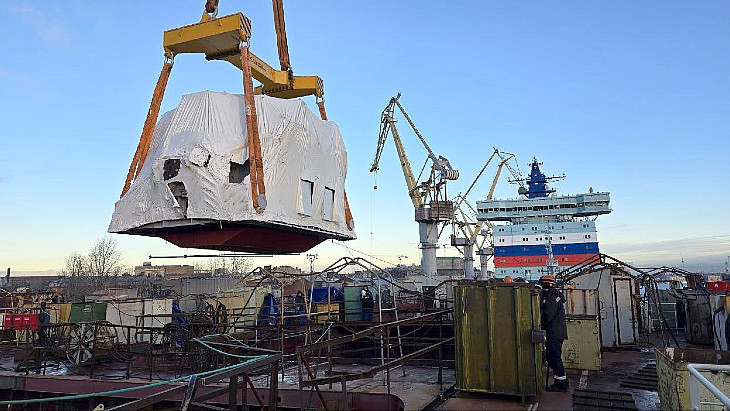 (Image: Rosatomflot)
That came just over two weeks after the ceremonial launch of the 173-metre long nuclear-powered icebreaker at the Baltic Shipyard. The Chukotka is 34 metres wide, with a height from the waterline to the mainmast of 57 metres. The height of its side is 15.2 metres and it is designed to break through ice up to three metres thick and has a speed of 22 knots in clear water. The Project 22220 icebreaker will be powered by two RITM-200 reactors which each have a thermal capacity of 175 MW. It already has the reactors on board and has a target completion date of 2026.