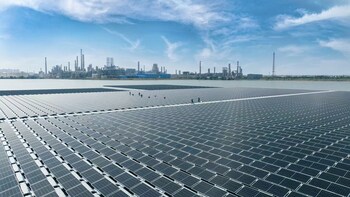
China Petroleum & Chemical Corporation (Sinopec), in collaboration with the Shandong Provincial Government and Qingdao Municipality, has officially commenced operations of the world’s first commercial-scale floating photovoltaic (PV) power project located entirely offshore. This marks a significant milestone in renewable energy innovation, as the project is not only fully marine-based but also integrated with a previously launched pile-mounted floating PV installation. It now stands as Sinopec’s largest floating solar power facility to date.
The project spans approximately 60,000 square meters and features an installed capacity of 7.5 megawatts. It is expected to generate around 16.7 million kilowatt-hours of renewable electricity annually, helping to reduce carbon emissions by an estimated 14,000 tons each year. Designed specifically for deployment in coastal and shallow marine environments, the floating PV plant makes efficient use of sea surface space while operating with zero emissions. The system has been engineered to adapt to tidal movements, maintaining minimal distance between the panels and the water surface. This configuration not only improves space utilization but also enhances the cooling effect, boosting power generation efficiency by 5 to 8 percent compared to traditional stilt-based systems.
To address the challenges posed by marine conditions, Sinopec introduced three major technical innovations. First, the floats and structural brackets have been developed with corrosion-resistant materials that can withstand salt spray and marine biofouling, including barnacle growth. Second, the anchoring system has been engineered to endure extreme offshore weather, including wind speeds up to Level 13, and can accommodate tidal variations of up to 3.5 meters.
This solution also reduces infrastructure investment by about 10 percent compared to conventional pile-based PV systems. Third, the layout has been optimized to simplify maintenance, with a streamlined inspection route and easier access to solar panels and cables located close to the water surface. This approach significantly improves operational safety and reduces ongoing maintenance costs.
The launch of this offshore solar plant adds to Sinopec’s broader new energy strategy. The company previously developed China’s first carbon-neutral hydrogen refueling station and its first industrial-scale seawater hydrogen production facility. The current floating PV project plays a central role in enabling solar-powered hydrogen generation, forming an essential part of Sinopec’s renewable energy industrial chain. Looking ahead, the company plans to expand the offshore solar plant to a total capacity of 23 megawatts, further strengthening its position in sustainable energy development.