Friday, 28 March 2025
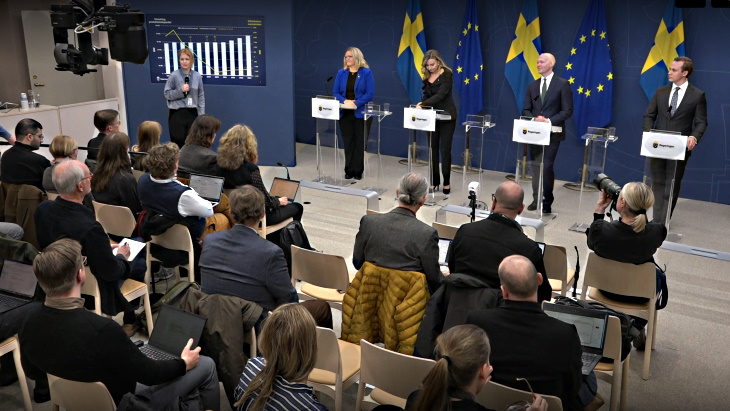
“In the bill, the government proposes a new law on state support for investments in new nuclear power,” the government said. “The law regulates the basic conditions and forms of state support for companies for investments in new nuclear power reactors in Sweden.”
It added: “Government loans may be provided for the construction and test operation of new nuclear power reactors, as well as for design and other preparatory measures for construction.”
The loans – aimed at lowering the cost of financing new nuclear – will be limited to the equivalent of four large-scale reactors (about 5000 MWe of capacity). The government said that several project companies may be eligible and there is the possibility for other private actors and the state to take shares in project companies.
“Two-way contracts for difference may be concluded for the routine operation of new nuclear power reactors. Support shall be subject to conditions regulated in agreements between the state and the company receiving support,” it added. These are aimed at reducing market risk.
The bill contains different scenarios for future electricity prices. In a scenario with lower electricity prices, it is assumed that the strike price is around SEK0.02 (USD0.002) per kWh higher than the electricity price.
The government noted that support may only be granted if the new reactors are located at the same location and have a total installed output of at least 300 MWe. “If there are special reasons, the government may decide to grant support even if the reactors have a total installed electrical output of less than 300 MW,” it said.
The new law is proposed to enter into force on 1 August this year.
Proposals welcomed
Vattenfall – which aims to have a new reactor in operation at its Ringhals site in the mid-2030s at the earliest – welcomed the government’s proposals for risk sharing for new nuclear power.
“The state taking a clear role in financing is a basic prerequisite for it to be possible to invest in new nuclear power,” said Desirée Comstedt, the company’s head of new nuclear power. “The bill is therefore a crucial step on the path towards us being able to realise new nuclear power on the Värö peninsula near Ringhals. Nuclear power is not being built anywhere in the world without some form of government support.
“The next step is for us to read the bill to review what an application should contain and prepare to submit our application as soon as possible. Ultimately, the levels of the parameters in the model will of course be an important factor, but these levels are set later in the process, after we have submitted an application.”
Earlier recommendations
In October 2022, Sweden’s incoming centre-right coalition government adopted a positive stance towards nuclear energy. In November 2023, it unveiled a roadmap which envisages the construction of new nuclear generating capacity equivalent to at least two large-scale reactors by 2035, with up to 10 new large-scale reactors coming online by 2045.
The government appointed Mats Dillén in December 2023 to produce and submit proposals for models for financing and risk sharing for the construction of new nuclear power reactors. According to the mandate, the proposed models must be designed so that nuclear power with a total output of at least 2500 MWe – equivalent to the output of two large-scale reactors – must be in place by 2035 at the latest.
Dillén presented the findings of the study in August last year. His report said the investigation “identified conditions which give rise to a discrepancy between a private investor’s business case for new nuclear power and the socioeconomic equivalent. It is concluded that efficiency reasons give a rationale for the state to support investments in nuclear power”.
His proposed financing and risk sharing model consists of three main components that lead to a lower cost of capital that facilitates new investments in nuclear power at a low cost. The components are: state loans to finance investments in new nuclear power, which lowers the cost of capital; a two-way contract-for-difference signed between the state and the nuclear power producer; and a risk and gain-share mechanism that gives investors a minimum return on equity.