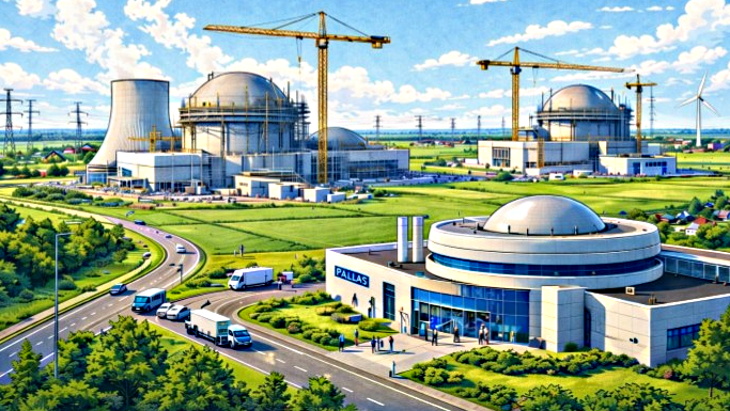
The study – – examined the potential societal value of the Pallas programme for the construction of future Dutch nuclear power plants.
The Pallas research reactor is being built at Petten to replace the existing High Flux Reactor (HFR), which began operating in September 1960 and supplies about 60% of Europe’s and 30% of the world’s medical radioactive sources. Pallas will be of the “tank-in-pool” type, with a thermal power of around 55 MW, and able to deploy its neutron flux more efficiently and effectively than the HFR. Construction was officially launched in September last year.
“Pallas primarily delivers social added value through risk reduction: fewer surprises, fewer redesigns, and fewer iterations with suppliers or the supervisory authority,” SEO said. “This predictability is important before construction begins, because many choices are made during this phase that later impact lead time and costs. At the same time, the learning effect is still developing and will only fully materialise if the acquired knowledge is actively retained and remains transferable.
“A scenario analysis shows that reducing construction delays by one to three years could yield significant financial benefits. For two nuclear power plants, the indicative total benefits range from EUR0.98 billion (USD1.16 billion) to EUR2.13 billion with a one-year reduction in delay to EUR2.96 billion to EUR6.41 billion with a three-year reduction in delay, primarily due to lower delay costs and an earlier start of the operational phase. In addition, smaller but positive savings are possible upfront (tens of millions of euros).”
NRG-Pallas said the construction of the new research reactor “presents an interesting case study because it is the first large-scale nuclear project in the Netherlands since the 1970s. With Pallas, the Netherlands has once again gained practical expertise in quality standards, safety, and supply chain qualification. The position of the supervisory authority, ANVS, has been strengthened with up-to-date expertise and experience”.
The report shows that the acquired knowledge primarily reduces risks by reducing the likelihood of redesign and fewer issues with suppliers or regulators, thus lowering the risk of delays. These learnings enable faster and more predictable operations on these types of projects. Pallas also contributes to strengthening the ecosystem by enabling a new generation of professionals to gain experience, and by enabling suppliers to invest in knowledge to meet nuclear quality standards.
In December 2021, the Netherlands’ new coalition government placed nuclear power at the heart of its climate and energy policy. In addition to keeping the Borssele plant in operation for longer, the government also called for the construction of new reactors. Based on preliminary plans, two new reactors will be completed around 2035 and each will have a capacity of 1000-1650 MWe. The two reactors would provide 9-13% of the country’s electricity production in 2035. The cabinet announced in December 2022 that it currently sees Borssele as the most suitable location for the construction of the new reactors. Three other locations are also being considered for the reactors: the Tweede Maasvlakte near Rotterdam, Terneuzen in Zeeland and Eemshaven in Groningen. The government is also taking steps to prepare the Netherlands for the possible deployment of small modular reactors.
“With Pallas, the Netherlands has been able to gain unique knowledge about the practical aspects of implementing a large-scale nuclear project,” said NRG-Pallas CEO Maurits Wolleswinkel. “Research agency SEO was asked whether it would be worthwhile to proactively retain this knowledge and manpower once the programme has completed all its various phases. The research confirms that the realisation of the Pallas reactor represents important pioneering work that could be of great value for the construction of new nuclear power plants. If the Netherlands retains and utilises this knowledge efficiently, its nuclear ambitions can be realised faster and at lower costs.”
“Interviews and studies show that the Pallas programme can significantly reduce both time and costs in the construction of new nuclear power plants,” said Erik Brouwer, head of the Competition, Aviation and Innovation group within SEO. “With NRG-Pallas, the Netherlands now has an organisation with recent experience in construction and permitting processes.”
The report has been submitted to Jan Anthonie Bruijn, Minister of Health, Welfare and Sport, and Sophie Hermans of the Ministry of Climate and Green Growth.
“The report confirms that the investment made by the Ministry of Health, Welfare and Sport extends beyond the domain of public health and is of great value to the Ministry of Health, Welfare and Sport’s major societal mission of achieving a sustainable and reliable energy supply,” NRG-Pallas said. “Intensive collaboration between the ministries and the use of this report will ensure that the knowledge and experience are retained and utilised to the fullest extent possible for the Netherlands.”