accelerates its transition toward a renewables-dominated grid, the conversation is rapidly shifting from capacity addition to system integration, reliability, and safety. Against this evolving landscape, Sungrow has introduced a suite of innovations—from advanced hybrid PV-storage solutions to a comprehensive energy storage safety framework—reinforcing its leadership in enabling next-generation power systems.
Reimagining Australia’s PV & Storage Landscape
Australia’s renewable sector is witnessing rapid growth, supported by strong policy momentum and increasing deployment of large-scale solar and storage assets. However, this expansion is also introducing new technical challenges around grid stability, system strength, and energy management.
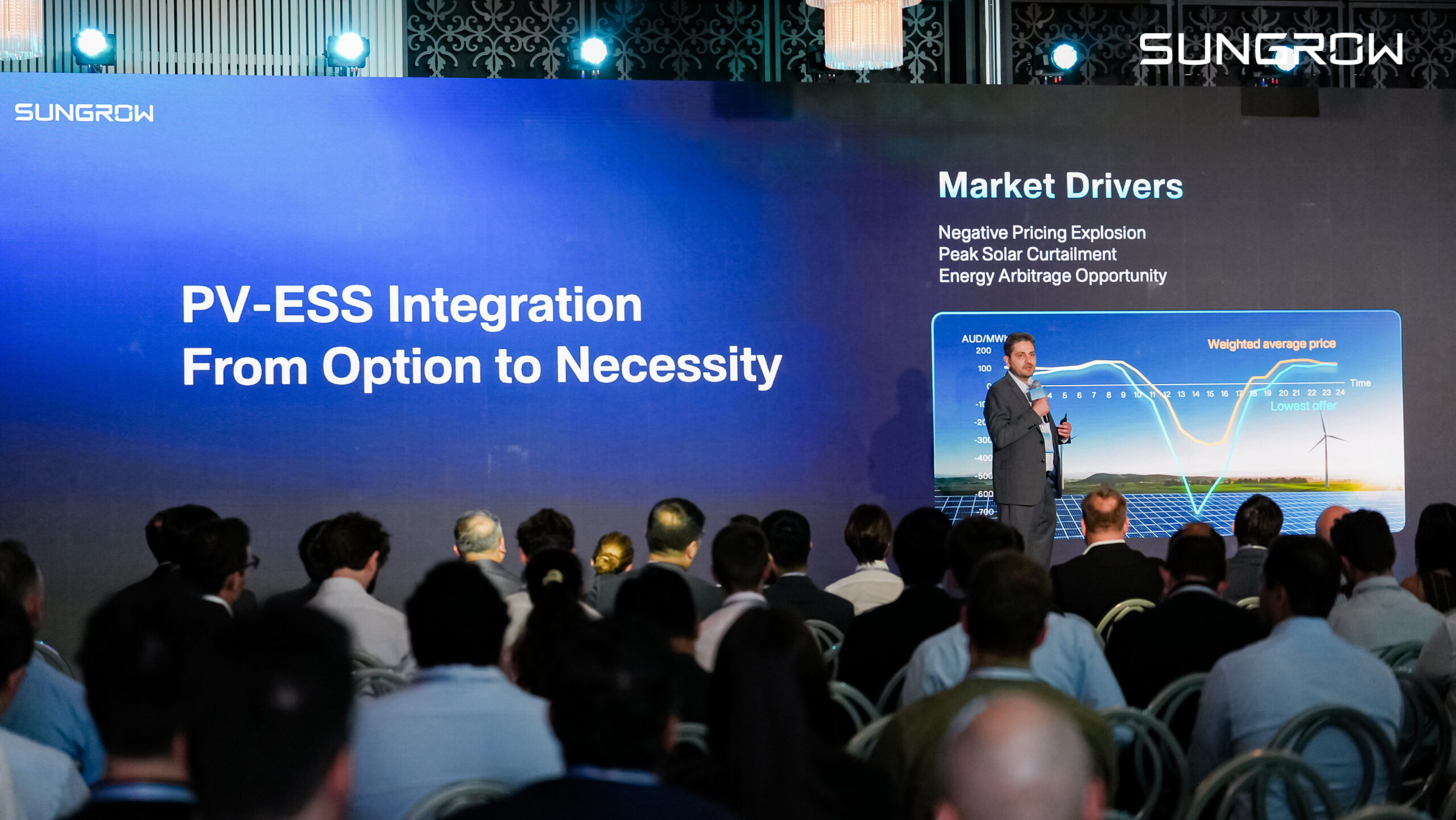
At the Sungrow PV & ESS Summit in Sydney, industry experts emphasized the growing importance of grid-forming (GFM) technologies in ensuring stable and resilient grids with high renewable penetration. These technologies enable critical capabilities such as voltage and frequency support, oscillation damping, and even black start functionality.
Sungrow highlighted its expanding footprint in Australia, backed by over a decade of market presence and large-scale project execution.
“Key projects such as the Cunderdin DC-coupled project, Templers BESS… demonstrate our capability to deliver at scale,” said Joe Zhou.
Hybrid PV-ESS Solution: Driving Efficiency and Grid Compatibility
To address emerging market challenges such as solar curtailment, negative pricing, and volatility in the National Electricity Market (NEM), Sungrow unveiled its DC-coupled Hybrid PV-ESS solution tailored specifically for Australian conditions.

The solution integrates:
- 1+X modular inverter with dedicated storage interface
- PowerTitan 3.0 with built-in DC/DC module
- PV-ESS Synergy Management System
This single-platform design enables seamless coordination between solar generation and battery storage, improving operational efficiency, enabling flexible dispatch, and enhancing grid compatibility.
Key performance highlights include:
- Up to 8-hour battery discharge duration
- High DC/AC ratio of up to 2.0
- Up to 100% ESS power utilization
The architecture also enables intelligent energy arbitrage—storing excess solar during low-price periods and dispatching during peak demand—ensuring stable, all-day renewable power delivery while maximizing project returns.
Optimising Lifecycle Performance and System Economics
Sungrow’s DC-coupled architecture delivers clear advantages in both cost and efficiency. By integrating storage on the DC side, the system eliminates the need for separate power conversion systems and reduces AC infrastructure requirements.
Crucially, the design reduces energy conversion stages from six to four, improving overall efficiency by 3–5%, while lowering system complexity and losses.
Beyond hardware, the integrated PV-ESS platform enhances:
- Faster installation and grid connection
- Adaptive performance under varying site conditions
- Long-term asset reliability through advanced control software
Supported by Sungrow’s local service network, the solution ensures end-to-end lifecycle optimisation for large-scale solar and storage deployments.
Elevating Energy Storage Safety with a Holistic Framework
Complementing its technology innovations, Sungrow has also taken a major step forward in addressing one of the industry’s most pressing challenges—energy storage safety.
In collaboration with TÜV Rheinland, Sungrow unveiled a joint white paper titled “Sungrow Energy Storage White Paper: A Holistic Approach to Safety.”

The white paper introduces a comprehensive safety framework that integrates:
- System-level protection across the entire architecture—from battery cells to grid
- Lifecycle safety management spanning design, manufacturing, operation, and decommissioning
As energy storage systems scale in size and complexity, traditional approaches are no longer sufficient. The white paper highlights the need for multi-layered, system-wide safety strategies to manage risks associated with high-density, gigawatt-scale deployments.
TÜV Rheinland’s independent validation further strengthens the framework, reinforcing industry confidence in adopting more rigorous, science-based safety methodologies.
Shaping a Resilient and Sustainable Energy Future
Together, Sungrow’s hybrid PV-ESS solution and safety-first approach signal a broader industry shift—from standalone technologies to fully integrated, intelligent, and secure energy systems.
By combining advanced system design, digital optimisation, and lifecycle safety management, Sungrow is not only addressing today’s grid challenges but also laying the groundwork for a more flexible, reliable, and sustainable energy future in Australia and beyond.
Sungrow, a global leader in renewable energy technology, has pioneered sustainable power solutions for over 29 years. As of December 2025, the company has installed over 1,000 GW of power electronic converters worldwide. Recognized by BloombergNEF as the world’s most bankable PV inverter and energy storage company, Sungrow supports global clean energy deployment through a network of over 520 service outlets.For more information, please visit:
Subscribe to get the latest posts sent to your email.