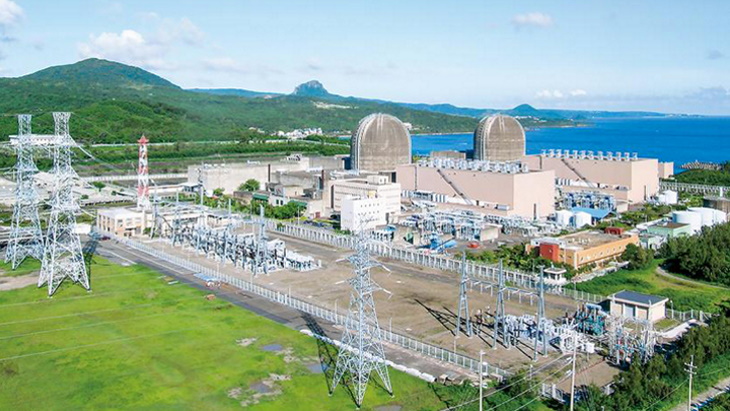
As Taiwan’s last operating reactor, Maanshan 2 had been providing about 3% of its electricity. On 17 May this year, it was disconnected from the grid and is set to be decommissioned following the expiry of its 40-year operating licence, in accordance with Taiwan’s nuclear phase-out policy.
A proposal to hold a referendum on restarting the Maanshan plant was passed in Taiwan’s Legislative Yuan a few days later. The Central Election Commission (CEC), which is an independent agency established to handle referendum issues, approved the referendum, setting the question as: “Do you agree that the third nuclear power plant (Maanshan) will continue to operate after the competent authority agrees to confirm that there are no safety concerns?”
According to the CEC, the total number of eligible voters was 20,020,091, with 5,906,370 actual voters, a turnout rate of just under 30%. Valid votes totalled 5,853,125, of which 4,341,432 votes (74%) were in favour, while 1,511,693 votes (26%) were against.
“A referendum proposal is considered passed if the number of valid votes in favour exceeds the number of votes against, and the number of valid votes in favour accounts for at least one-quarter of the total number of voters,” the CEC said. “The number of valid votes in favour did not reach more than a quarter of the total number of voters, resulting in a rejection.”
The CEC said it will hold a committee meeting on 29 August to review the voting results and announce them in accordance with the law. “Within two years of announcing the referendum results, the competent authority may not resubmit the same proposal,” it noted.
Speaking following the announcement of the referendum result, President Lai Ching-te said that the voting results “reflect the will of the people and we must all respect and accept them”.
He added: “Throughout decades of debate on the nuclear power issue, the single greatest consensus in Taiwanese society has been safety. Safety isn’t just a scientific issue; it’s also a matter of public peace of mind. However, as I stated before the referendum, nuclear safety is a scientific issue, one that requires scientific verification and cannot be fully resolved in a single referendum.
“Regarding whether nuclear power plants can be restarted, according to the Nuclear Control Act, which was amended in May this year, the government’s position is that there are ‘two musts’ in terms of procedures: the first must be that the Nuclear Safety Council must establish a safety review method; the second must be that Taipower must conduct independent safety inspections in accordance with this method.”
Lai called for the Nuclear Safety Council “to consult with all sectors of society and finalise the relevant measures as soon as possible. I would also like to ask Taipower to initiate self-safety inspections of its older nuclear power units after the regulations are announced, and to regularly report progress and risks to the public. If they meet the standards, they will be submitted to the Nuclear Safety Council for review in accordance with the law. The government will adhere to the ‘Three Principles’: nuclear safety is assured, a solution to nuclear decommissioning is available, and there is social consensus. This is our firm stance on the issue of nuclear energy.
“Therefore, if future technology is safer, produces less nuclear waste, and is more socially acceptable, we will not rule out advanced nuclear energy.”
Taiwan’s Democratic Progressive Party (DPP) was elected to government in January 2016 with a policy of creating a “nuclear-free” Taiwan by 2025. Under this policy, Taiwan’s six operable power reactors would be decommissioned as their 40-year operating licences expire. Shortly after taking office, the DPP government passed an amendment to the Electricity Act, passing its phase-out policy into law. The government aims for an energy mix of 20% from renewable sources, 50% from liquefied natural gas and 30% from coal.
However, in a referendum held in November 2018, voters chose to abolish that amendment. The Ministry of Economic Affairs said the amendment was officially removed from the Electricity Industry Act on 2 December.
Nevertheless, then Minister of Economic Affairs Shen Jong-chin said in January 2019 “there would be no extension or restarts of nuclear power plants in Taiwan due to subjective and objective conditions, as well as strong public objection”.