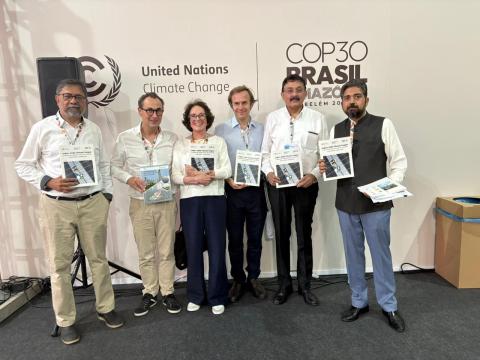
The Energy and Resources Institute (TERI) held a high-level official UNFCCC Press Conference at COP30, focusing on India’s rapidly expanding industry-led climate action and the country’s growing role in shaping global pathways toward net-zero emissions. The event, titled “Accelerating India’s Industry-Led Climate Action for a Net-Zero Future,” brought together leading voices from climate science, sustainable finance, international coalitions, and industry to emphasize the urgent need for cross-sector collaboration in driving decarbonization. The session discussed how Indian businesses are increasingly taking ambitious steps toward climate commitments and global partnerships, supported by TERI’s long-standing initiatives such as the Industry Charter for Near Zero Emissions Ambition by 2050.
During the conference, Mr Arupendra Nath Mullick, Associate Director at TERI, expressed appreciation for the strong participation and collaboration from India, Brazil, and COP30 partners. Adding to this, Mr Dipak Dasgupta, Distinguished Fellow at TERI, IPCC AR6 author, and Member of the COP30 Presidential Scientific Council, highlighted that the success of COP30 will depend heavily on a credible climate finance roadmap, increased adaptation funding, and stronger protection of critical ecosystems such as the Amazon.
He explained that new financial directions are emerging that could triple funding flows and shared that COP30 will see the formation of a multi-sovereign guarantee fund designed to support the next phase of climate action. He also noted the establishment of a design lab to demonstrate how large-scale, next-generation climate investments—including carbon capture and green hydrogen—can be financed effectively. He stressed that achieving a just transition requires financing not only at the national level but also at sub-national levels, driven by strong South–South cooperation.
Dr Thelma Krug, Former Vice-Chair of the IPCC and Chair of the COP30 Presidential Scientific Council, spoke about the scientific urgency behind COP30 and praised the emerging Brazil–India leadership in connecting industrial transitions with climate resilience. She noted that although it is very unlikely the world will be able to limit warming to 1.5°C immediately, exceeding this threshold temporarily does not signify irreversible loss. She emphasized that with the right actions and sufficient carbon removal, the world can still return to the 1.5°C pathway.
Industry representatives, including Mr Andrew Prag from the We Mean Business Coalition, Mr Thomas Guillot from the Global Cement and Concrete Association, and Ms Julia Souder from the Long Duration Energy Storage Council, shared perspectives on scaling low-carbon technologies, strengthening global coalitions for sectoral transformation, and advancing long-duration energy storage as a core component of net-zero energy systems. Mr Prag highlighted survey findings showing that 99% of Indian business leaders support a rapid shift to renewable energy, with most aiming for this transition within the next decade.
He explained that a strong and investable Nationally Determined Contribution (NDC) would signal long-term clarity to industry while unlocking opportunities across electrification in transport, buildings, and industrial sectors. Similarly, Mr Guillot pointed out the delays faced by carbon capture projects in Europe due to inadequate transport infrastructure and recommended that India adopt integrated cross-industry planning to avoid such challenges, especially as India plays a critical role in global decarbonization. Ms Souder added that as renewable energy expands worldwide, energy storage and grid management have become essential elements in countries ranging from Brazil to India.
Speaking on behalf of India’s automotive sector, Mr Jyotin S Kutty, Vice President and Chief Sustainability Officer at Tata Motors Ltd, emphasized the growing momentum toward clean mobility and the value of TERI’s multi-stakeholder platforms in shaping climate solutions aligned with national policy. Mr Arupendra Nath Mullick further stressed that COP30 represents ten years since the Paris Agreement and highlighted India’s vital role in fostering innovation-driven public–private climate partnerships supported by South–South cooperation.
Reflecting on the discussions, Dr Vibha Dhawan, Director General of TERI, noted that businesses play an increasingly important role in shaping future climate pathways as they adopt measures focused on clean energy and resource efficiency. She emphasized the importance of sharing these initiatives to inspire broader action and encouraged the adoption of ambitious climate targets that reflect technological advancements and real-world industry progress. The Press Conference concluded by underscoring the importance of strengthening financing mechanisms, accelerating technological innovation, and aligning industrial strategies with global climate objectives to drive long-term sustainable transformation.
Subscribe to get the latest posts sent to your email.