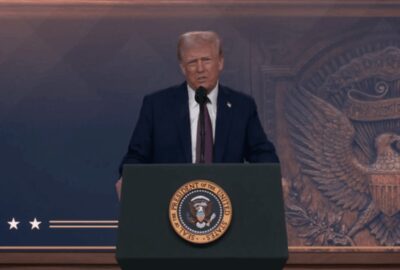
U.S. President Donald Trump’s new 25% tariffs on imports from Mexico and Canada took effect on Tuesday, along with a doubling of duties on Chinese goods to 20%, launching new trade conflicts with the top three U.S. trading partners.
The tariff actions, which could upend nearly $2.2 trillion in two-way annual U.S. trade went live at 12:01 a.m. EST (0501 GMT), hours after Trump declared that all three countries had failed to do enough to stem the flow of the deadly fentanyl opioid and its precursor chemicals into the U.S.
Canada and Mexico, which have enjoyed a virtually tariff-free trading relationship with the U.S. for three decades, were poised to immediately retaliate against their longtime ally.
Canadian Prime Minister Justin Trudeau said Ottawa would respond with immediate 25% tariffs on C$30 billion ($20.7 billion) worth of U.S. imports, and another C$125 billion ($86.2 billion) if Trump’s tariffs were still in place in 21 days. He said previously that Canada would target American beer, wine, bourbon, home appliances and Florida orange juice.
“Tariffs will disrupt an incredibly successful trading relationship,” Trudeau said, adding that they would violate the U.S.-Mexico-Canada free trade agreement signed by Trump during his first term.
Ontario Premier Doug Ford told NBC that he was ready to cut off shipments of nickel and transmission of electricity from his province to the U.S. in retaliation.
Mexican President Claudia Sheinbaum was expected to announce her response during a morning news conference in Mexico City on Tuesday, the country’s economy ministry said.
STACKING CHINA TARIFFS
The extra 10% duty on Chinese goods adds to a 10% tariff imposed by Trump on February 4 to punish Beijing over the U.S. fentanyl overdose crisis. The cumulative 20% duty also comes on top of tariffs of up to 25% imposed by Trump during his first term on some $370 billion worth of U.S. imports.
Some of these products saw U.S. tariffs increase sharply under former president Joe Biden last year, including a doubling of duties on Chinese semiconductors to 50% and a quadrupling of tariffs on Chinese electric vehicles to over 100%.
The 20% tariff will apply to several major U.S. consumer electronics imports from China previously untouched by prior duties, including smartphones, laptops, videogame consoles, smartwatches and speakers and Bluetooth devices.
China’s commerce ministry on Tuesday vowed countermeasures but offered no specifics as it said Washington mistakenly “shifted the blame” for its fentanyl crisis to Beijing. The state-backed Global Times newspaper said on Monday Beijing’s retaliation would most likely target U.S. agricultural and food products.
U.S. farmers were hard hit by Trump’s first-term trade wars, which cost them about $27 billion in lost export sales and conceded share of the Chinese market to Brazil.
The tariffs on Mexican and Canadian products could have much deeper repercussions for a highly integrated North American economy that depends on cross-border shipments to build cars and machinery, refine energy and process agricultural goods.
“Today’s reckless decision by the U.S. administration is forcing Canada and the U.S. toward recessions, job losses and economic disaster,” Canadian Chamber of Commerce CEO Candace Laing said in a statement.
She said the U.S. tariffs will fail to usher in a “golden age” coveted by Trump but instead raise costs for consumers and producers and disrupt supply chains. “Tariffs are a tax on the American people.”
Matt Blunt, president of the American Automotive Policy Council representing Detroit automakers, called for vehicles that meet the U.S.-Mexico-Canada Agreement’s regional content requirements to be exempted from the tariffs.
Even before Trump’s tariffs announcement, U.S. data on Monday showed factory gate prices jumped to a nearly three-year high, suggesting that a new wave of tariffs could soon undercut production.
Trump’s confirmation that the tariffs would proceed sent financial markets reeling with global stocks tumbling and safe-haven bonds rallying. Both the Canadian dollar and Mexican peso fell against the greenback.
PILING ON
Trump has maintained a blistering pace of tariff actions since taking office in January, including fully restored 25% tariffs on steel and aluminum imports that take effect March 12, rescinding prior exemptions.
Trump’s “America First” agenda, aimed at redrawing trade relationships in favor of the U.S., is expected to be a centerpiece of his Tuesday night address to a joint session of Congress.
Trump on Saturday opened a national security investigation into imports of lumber and wood products that could result in steep tariffs. Canada, already facing 14.5% U.S. tariffs on softwood lumber, would be hit particularly hard.
A week earlier, Trump revived a probe into countries that levy digital services taxes, proposed fees of up to $1.5 million on every Chinese-built ship entering a U.S. port and launched a tariff investigation into copper imports
These add to his plans for higher “reciprocal tariffs” to match the levies of other countries and offset their other trade barriers, a move that could hit the European Union hard.
(Reporting by David Lawder and Andrea Shalal; additional reporting by David Shepardson in Washington, David Ljunggren and Ismail Shakil in Ottawa, Kylie Madry and Ana Isabel Martinez in Mexico City and Joe Cash in Beijing; Editing by Sam Holmes)
Share This:
More News Articles