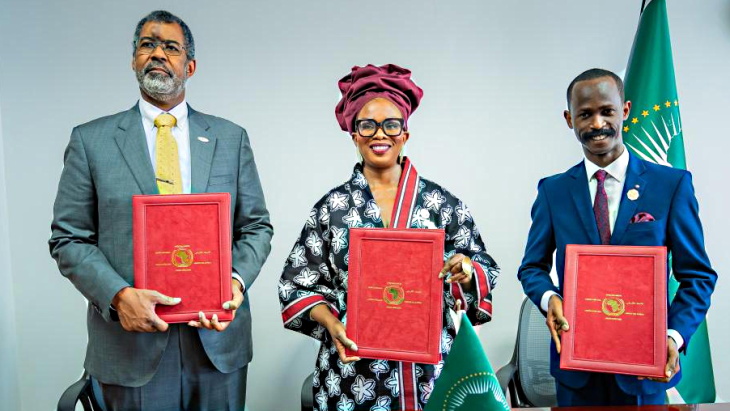
The partnership was formalised on 13 February on the margins of the 39th African Union Summit in Addis Ababa, Ethiopia. The MoU was signed by William Magwood, Director-General of the OECD Nuclear Energy Agency (NEA); Lerato Mataboge, Commissioner for Infrastructure and Energy at the African Union (AU) Commission; and Gaspard Liyoko Mboyo, chairperson of the African Commission on Nuclear Energy (AFCONE).
The cooperation framework will focus on: promoting peaceful nuclear applications for socio-economic development in AU Member States; supporting skills development and industrial capacity building; enhancing policy, regulatory, and technical frameworks; and facilitating joint events, knowledge exchange, and collaborative research initiatives.
The MoU will remain valid for an initial period of three years, with the possibility of renewal subject to review.
“Today, we stand at a defining moment in Africa’s energy journey,” said Mataboge. “Under the leadership of the African Union and guided by Agenda 2063, this memorandum of understanding represents more than a partnership – it is a strategic step toward strengthening Africa’s energy sovereignty and advancing the peaceful use of nuclear energy as a catalyst for industrialisation, resilience, and sustainable development across our continent. This MoU we are signing signifies our collective commitment to fostering cooperation, sharing knowledge, and building the institutional and technical capacity required to power Africa’s transformation.”
She added: “Africa supplies a significant share of the world’s mined uranium – around 15–18% – with major production in Namibia, Niger and South Africa, yet the continent contributes less than 1% to global nuclear electricity generation. This imbalance underscores the opportunity for Africa to harness its resources for value-added development at home.”
“It is a distinct honour to join this landmark event, which initiates a new chapter in strengthening nuclear cooperation between Africa and the international community,” Mboyo said. “This MoU is not a bureaucratic exercise, but a strategic step toward building the most secure and sustainable nuclear cooperation, at a critical time when Africa is seeking to meet its massive energy needs while advancing Agenda 2063 and responding to the global call for low-carbon and sustainable energy trajectories.”
Magwood said: “This memorandum of understanding provides a framework for the OECD Nuclear Energy Agency to share its expertise and technical advice in support of Africa’s peaceful nuclear energy ambitions. We are grateful to all those who have worked over a long period to make this agreement possible, and we thank African partners who are eager to collaborate to usher in a new era of shared prosperity.”
He noted that the NEA will contribute global best practices, data-driven policy analysis, and technical knowledge to support Africa in developing robust nuclear programmes, building human capital, and strengthening regulatory and institutional capacity across the continent.
The NEA launched the Common Journey Initiative to enhance co-operation between the NEA and African countries that have decided to pursue development of nuclear energy programmes. These efforts will continue under the aegis of the new MoU.
South Africa is the only African country currently utilising nuclear energy, which accounts for about 5% of its electricity generation, with a total installed capacity of 1,854 GW. Egypt is currently in the process of building a 4.8 GW power plant to be completed in 2031. Algeria, Ethiopia, Ghana, Kenya, Morocco, and Nigeria also plan to launch nuclear energy programmes.