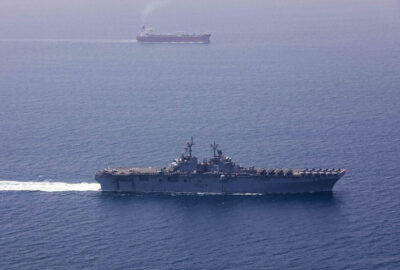
In a statement posted on his Truth Social page late on March 13, U.S. President Donald Trump announced a “bombing raid” at Kharg Island.
“Moments ago, at my direction, the United States Central Command executed one of the most powerful bombing raids in the History of the Middle East, and totally obliterated every MILITARY target in Iran’s crown jewel, Kharg Island,” Trump said in the statement.
“Our Weapons are the most powerful and sophisticated that the World has ever known but, for reasons of decency, I have chosen NOT to wipe out the Oil Infrastructure on the Island,” he added.
“However, should Iran, or anyone else, do anything to interfere with the Free and Safe Passage of Ships through the Strait of Hormuz, I will immediately reconsider this decision,” Trump warned.
“During my First Term, and currently, I rebuilt our Military into the Most Lethal, Powerful, and Effective Force, by far, anywhere in the World. Iran has NO ability to defend anything that we want to attack – There is nothing they can do about it!,” Trump went on to state.
“Iran will NEVER have a nuclear weapon, nor will it have the ability to threaten the United States of America, the Middle East or, for that matter, the World!,” he said.
Rigzone has contacted the Iranian Ministry of Foreign Affairs for comment on Trump’s Truth Social post. At the time of writing, the ministry has not responded to Rigzone.
In an oil flash note sent to Rigzone on Saturday by Natasha Kaneva, J.P. Morgan’s head of global commodities strategy, analysts at the company, including Kaneva, highlighted that Trump “announced Friday night that the U.S. military conducted heavy strikes on military targets on Iran’s Kharg Island, which handles roughly 90 percent of Iran’s crude exports, while avoiding the island’s oil infrastructure”.
“The President warned that Iran’s energy assets would be targeted if Tehran continues to impede shipments through the Strait of Hormuz,” the analysts added.
In the note, the J.P. Morgan analysts pointed out that news was “limited”, but in “initial remarks” said “the impact on the oil supply would likely be limited”.
“If loading jetties, storage tanks, and pipelines remain intact, Iran’s export capacity would be largely unchanged, and the country could still ship roughly 1.5-1.7 million barrels per day of crude. Any disruption would likely be temporary and precautionary,” they added.
The analysts also outlined that the development “marks an escalation in the conflict”.
“Until now, the region’s oil infrastructure has largely been spared,” the analysts said.
In a market comment sent to Rigzone on Monday morning, Aaron Hill, Chief Market Analyst at FP Markets, said, “what started as a military operation involving the U.S., Israel, and Iran has since metastasized into a global geopolitical firestorm with profound economic consequences”.
“Brent Crude spiked to highs just shy of $120 per barrel early last week and settled around $104, up nearly 11.3 percent. WTI Crude spiked to similar highs, though it concluded the week just south of $100, up 8.8 percent,” he added.
“The IEA [International Energy Agency] described the oil shock as ‘the largest supply disruption in the history of the global oil market’, and stated that member countries are expected to release an unprecedented amount of emergency oil supply – 400 million barrels,” he continued.
“To put this into context, this is more than double the amount of oil released in 2022 when Russia invaded Ukraine,” Hill highlighted.
In the market comment, Hill noted that the Strait of Hormuz is “key”.
“Approximately 20 percent of global seaborne oil (including Gas and other refined oil products) has ground to a halt,” he pointed out.
“The duration of this war and how long the Strait remains blockaded will decide the ultimate outcome here,” he added.
“Naturally, recession calls have increased, and the longer this conflict lasts, the worse it will be for the economy,” Hill warned.
In a release sent to Rigzone late Friday, Rystad Energy noted that, “in just over a week since the U.S.-Israeli strikes on Iran triggered the closure of the Strait of Hormuz, more than 12 million barrels of oil equivalent per day of Middle East oil and gas production has been taken offline, including seven million barrels per day of crude supply – equivalent to roughly seven percent of total global liquids demand”.
Rystad warned in that release that “the worst is likely yet to come”.
“Rystad Energy analysis shows that in a worst-case scenario, Middle East crude output could fall to approximately six million barrels per day, a region-wide reduction of 70 percent from the pre-conflict baseline,” the company said.
In the release, Aditya Saraswat, MENA research director at Rystad Energy, noted that “further cuts from major Middle East oil producers cannot be ruled out as storage tanks fill to the brim, bypass infrastructure approaches its limit, and the conflict shows no sign of a near-term resolution”.
“Although the likelihood of oil supply falling to six million barrels per day is not our central case, it is still very much in the cards,” Saraswat warned.
“If and when the crisis reaches an end, it will take months to restore operations to pre-conflict levels, with the questions of infrastructure integrity and a recalibrated geopolitical order still at play,” Saraswat continued.
Rigzone has contacted the White House, the Iranian Ministry of Foreign Affairs, and Israel’s Ministry of Foreign Affairs for comment on JPM’s note, Hill’s statement, and Rystad’s release. Rigzone has also contacted the General Secretariat of the Gulf Cooperation Council for comment on Rystad’s release. At the time of writing, none of the above have responded to Rigzone.
In a Skandinaviska Enskilda Banken AB (SEB) report sent to Rigzone on Friday, SEB Chief Commodities Analyst Bjarne Schieldrop warned that .
“For example, Iran’s Kharg island which is Iran’s major oil export hub,” Schieldrop highlighted in the report.
To contact the author, email