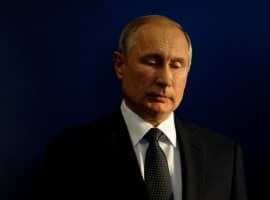
President Donald Trump has threatened secondary sanctions on Russia’s energy industry if Washington and Moscow fail to seal a ceasefire deal for Ukraine.
“If Russia and I are unable to make a deal on stopping the bloodshed in Ukraine, and if I think it was Russia’s fault — which it might not be — but if I think it was Russia’s fault, I am going to put secondary tariffs on oil, on all oil coming out of Russia,” Trump told NBC in an interview.
‘;
document.write(write_html);
}
Trump also said he was “pissed off” with comments that Russia’s Vladimir Putin made about the legitimacy of Volodymyr Zelensky’s government and the suggestion that the Ukrainian leadership must change if a peace agreement is to be legitimate. Russia’s president has repeatedly argued that elections in Ukraine are key to the success of the peace-negotiations process.
It seems President Trump’s idea for additional punishment of Russia’s energy industry is the same as the one adopted with regard to Venezuela. As Trump explained it to NBC, “That would be that if you buy oil from Russia, you can’t do business in the United States. There will be a 25% tariff on all oil, a 25- to 50-point tariff on all oil.”
Such a step would almost certainly push oil prices considerably higher, given Russia’s weight as an oil exporter, and that would go against Trump’s promise for cheap energy. The 25% secondary tariffs on Venezuelan oil already had that effect on benchmarks. The tariff is activated for any trade with the U.S. of a country that imports Venezuelan crude.
Immediately after Trump’s announcement of the tariffs, loadings of Venezuelan oil slowed, according to a Bloomberg report from the end of last week. This pushed Brent crude and West Texas Intermediate to a third consecutive gain, although this week trade began with a dip for both benchmarks.
By Irina Slav for Oilprice.com
More Top Reads From Oilprice.com
- Trump: 25% Tariff On Anyone Who Buys Venezuelan Oil & Gas
- Iraq Hands BP Final Approval for Kirkuk Oil Development
- India Turns Away Russian Oil Tanker As Sanctions Evolve