By

BERLIN, Feb 26 (Reuters Breakingviews) – The minerals deal that U.S. President Donald Trump could soon sign with Ukraine may not be the colonial-style asset grab it appears to be. President Volodymyr Zelenskiy can still turn it to his country’s long-term advantage.
Giving Washington a piece of Ukraine’s critical minerals and other resources was an idea Zelenskiy took to then-candidate Trump back in September, hoping it would align the two countries’ commercial interests. The Ukrainian leader got more than he’d bargained for after the November election, when Trump started talking about some $500 billion he expected as “money back” for the financial and military support the U.S. has channelled to the country since Russia invaded three years ago.
The two countries have been discussing an agreement that would require Ukraine to pay half the revenue it will extract from the future monetisation of natural resources to a special fund controlled by the U.S., the New York Times reported. The fund would be tasked with reinvesting part of the proceeds in Ukraine, as a catalyst for attracting overseas capital. The U.S. appears to have dropped the $500 billion demand, which never made much sense. American civil and military support to Kyiv over the last three years amounted to 114 billion euros, according to the Kiel Institute for the World Economy. Over the same period, European countries sent 132 billion euros.
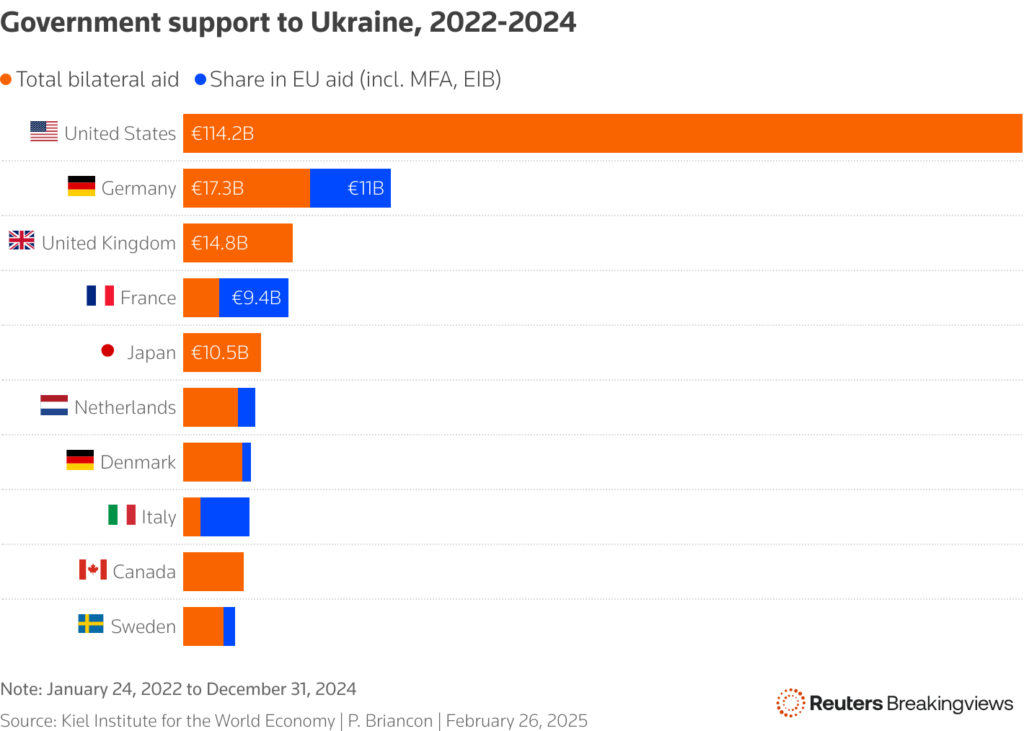
A bar chart showing government support to Ukraine between 2022 to 2024
One big unknown is the scale of Ukraine’s assets. Local authorities have a poor picture of their country’s underground resources, which include uranium, lithium, oil and gas. The last mapping of so-called rare-earth metals was completed decades ago, and the deposits may not be viable. Besides, some of the coveted elements are in territory occupied by Russia.
Furthermore, any revenue is years away. Ukraine will first have to build or rebuild mines and repair the country’s damaged energy grid. The promise of future returns could spur U.S. investment, thereby beginning the rebuilding of Ukraine, a task the World Bank estimates will cost $524 billion.
Zelenskiy wanted any deal to be conditional on American involvement in policing a truce with Russia. That condition appears to have run up against the Trump administration’s opposition to military involvement in Europe. But the Ukrainian leader has also stated that giving the U.S. an interest in the country’s economic future would achieve the same outcome. Indeed, Russia doesn’t like the mooted deal – and President Vladimir Putin has offered the U.S. a mineral agreement of his own.
Zelenskiy might also conclude that a general agreement covering unknown assets with distant revenue may not bind Kyiv much. By the time the mines are up and running, the U.S. may have a friendlier president. Ukraine could then review the contract or tear it up altogether. It’s a negotiating strategy Trump might even admire.
Follow , on X
CONTEXT NEWS
The U.S. and Ukraine have agreed on the terms of a draft minerals deal central to Kyiv’s push to win Washington’s support as President Donald Trump seeks to rapidly end the war with Russia, Reuters reported on February 25 citing two sources with knowledge of the matter.
A source familiar with the contents of the draft agreement said that it does not specify any U.S. security guarantees or continued flow of weapons but says that the United States wants Ukraine to be “free, sovereign and secure.”
U.S. President Donald Trump indicated that his counterpart Volodymyr Zelenskiy might visit Washington on February 28 to sign the agreement. “I understand it’s a big deal, very big deal,” he said in the Oval Office on February 25.
Editing by Peter Thal Larsen and Streisand Neto
Share This:
More News Articles