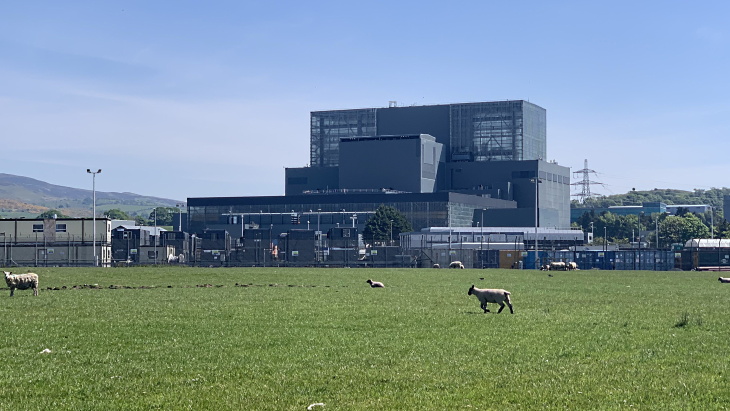
The site will now be managed by the Nuclear Decommissioning Authority’s (NDA’s) subsidiary Nuclear Restoration Services (NRS), which is also decommissioning the neighbouring Hunterston A site. It becomes the first Advanced Gas-cooled Reactor (AGR) plant to successfully transfer into UK government ownership.
The UK’s Office for Nuclear Regulation formally approved the relicensing of the Hunterston B plant from EDF Energy to NRS on 18 March, marking the beginning of the site’s decommissioning phase. The licence, which took effect at the point of site transfer, is a legal document that will see responsibility for the site move from EDF to NRS. It sets out the conditions under which the site can operate and is crucial for future decommissioning work to proceed.
“Hunterston B has been an integral part of the EDF family,” said EDF Energy’s Decommissioning Director Paul Morton. “It is a fantastic site and while we will miss the station and its people, we know they are entering an exciting new chapter in their story, and we are looking forward to seeing them successfully delivering decommissioning. I am delighted we have been able to work with NRS and the NDA to deliver this transfer on schedule.
“This has been a first-of-a-kind project, with people at its heart. We have worked hard with staff and unions to support everyone on site over the past four years and almost every person has been able to secure the outcome they wanted, with most continuing to work at Hunterston B or staying with EDF.”
The Hunterston B plant comprises two 490 MWe AGRs – Reactors 3 and 4. Reactor 3 came online for the first time in February 1976, was initially expected to run for 25 years but had its generating lifespan increased to more than 45 years. It was taken offline in November 2021. The plant’s other unit, Reactor 4, started up in March 1977 and was shut down in January 2022. In April last year, Hunterston B became the first of the UK’s seven AGR power plants to be declared free of all used nuclear fuel ahead of decommissioning.
Decommissioning of the site will involve dismantling nuclear facilities and removing any associated radioactive waste for safe storage or disposal which includes removing all plant, equipment, services and buildings outside of the reactor building. After the decommissioning process is complete, the site will enter a period of care and maintenance. Decommissioning is being carried out using funds from the Nuclear Liabilities Fund (NLF), a ring-fenced GBP20.7 billion (USD27.3 billion) fund set up in 1996 specifically to pay for the decommissioning of the current nuclear fleet.
“The NLF funding model provides certainty that funds are now available to support safe and secure site remediation,” said NLF Chief Executive Melissa Hope. “We look forward to working with the station, NRS, the NDA and HM Government going forward to ensure that NLF funds are used to support planning for and innovation in the decommissioning programme, with the aim of this important national task being delivered efficiently and cost-effectively.”
Decommissioning of AGRs
EDF had originally been responsible for total lifetime decommissioning of the seven AGR plants, which comprise Torness and Hunterston B in Scotland, Dungeness B in Kent, Hartlepool in Teesside, Heysham 1 and 2 in Lancashire and Hinkley Point B in Somerset. All these plants are scheduled to reach the end of their operational lives this decade.
However, in June 2021, the UK government and EDF agreed improved arrangements to safely and efficiently decommission the AGRs. Under the agreement, EDF will aim to shorten the time it takes to safely remove the fuel from the plants as they come offline, before working closely with the NDA to transfer ownership of the stations to the NDA.
Ownership of Hinkley Point B in Somerset is due to transfer to the NDA later in 2026.
Four AGR plants are still in operation. Hartlepool and Heysham 1 are currently expected to operate until March 2028. Heysham 2 and Torness are currently due to generate until March 2030.