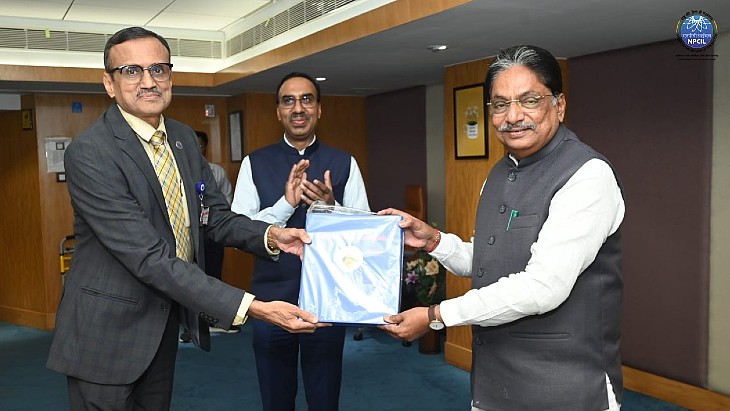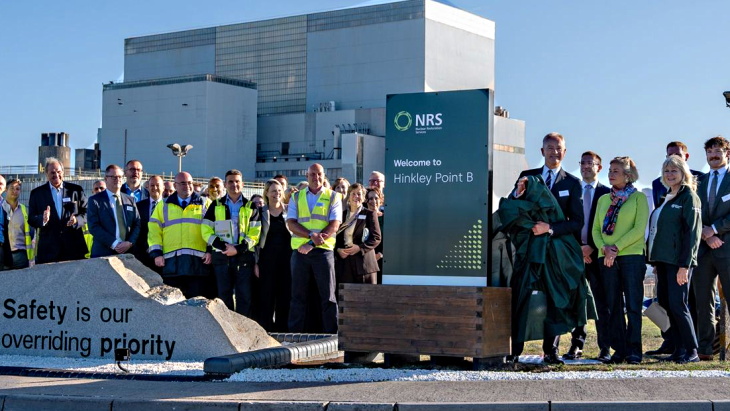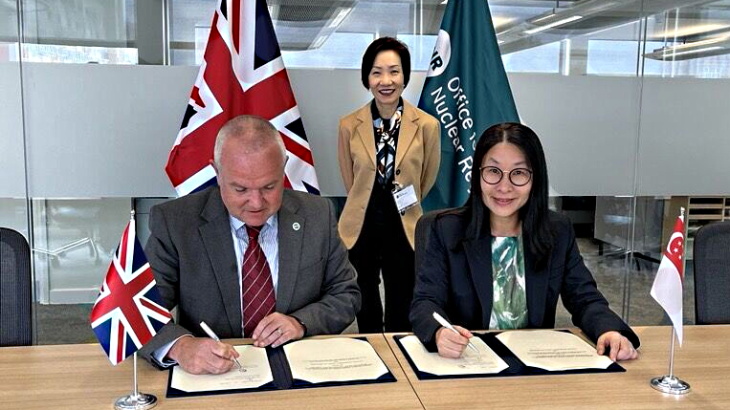
The MoU was signed at the Office for Nuclear Regulation’s (ONR’s) office in London by Paul Dicks, its Director of Regulation – New Reactors, and Li-Na Koh, Deputy Chief Executive Officer of the National Environment Agency (NEA), and witnessed by Grace Fu, Singapore’s Minister for Sustainability and the Environment.
The MoU – valid for five years – establishes a framework for exchanging safety-related regulatory information across the full nuclear lifecycle – from siting, construction and commissioning through to operations, decommissioning and waste management. It also covers the regulation of transporting radioactive material, radioactive sources, emergency preparedness, and importantly, regulatory considerations around new reactor technologies. The agreement provides for personnel exchanges and technical visits, helping the development of regulatory capability on both sides.
The partners also agreed to implement a workplan that will support sharing of information that delivers mutual benefit to both parties, and specify the focus areas for collaboration and desired outcomes.
“Sharing licencing frameworks, inspection procedures, safety assessments and research helps ensure that robust regulatory standards keep pace with technological development, wherever in the world that development is happening,” ONR said. “This is part of our commitment to support embarking nations in the deployment of nuclear technologies and contribution to worldwide nuclear harmonisation and we were happy to explain and talk through our assessment and licencing processes to the Singapore delegation as they work to establish a new nuclear regulatory framework.”
NEA said the cooperation with ONR supports Singapore’s overarching effort to build capabilities in nuclear safety, and to study the feasibility of the safe deployment of nuclear energy in the island city-state.
“The MoU with the United Kingdom’s Office for Nuclear Regulation will strengthen Singapore’s capabilities in radiation protection, nuclear safety and assessment,” Koh said. “Through partnerships with well-established regulators like ONR, NEA will deepen its technical expertise to understand new reactor technologies and build the institutional capabilities needed to rigorously assess nuclear safety.”
The NEA, as the radiation and nuclear safety regulator, has been developing Singapore’s nuclear safety capabilities through close partnerships with the International Atomic Energy Agency and established regulatory bodies in Finland, France and the USA, as well as its regional neighbours with whom it engages in nuclear safety cooperation discussions.
In March 2022, the EMA released a report that concluded nuclear energy could supply about 10% of Singapore’s energy needs, helping its power sector achieve net-zero carbon emissions by 2050.
In September last year, the EMA appointed UK-headquartered engineering firm Mott MacDonald to conduct a study on the safety and technical feasibility of advanced nuclear energy technologies. The study aims to evaluate the safety performance and technical feasibility of advanced nuclear energy technologies, such as small modular reactors, based on their safety features, technology maturity, and commercial readiness.
Delivering his Budget 2025 speech in February 2025, Prime Minister Lawrence Wong – who is also Finance Minister – said the government would study the potential deployment of nuclear power in Singapore and take further steps to systematically build up capabilities in this area. “We will need new capabilities to evaluate options, and to consider if there is a solution that Singapore can deploy in a safe and cost-effective way,” he said.