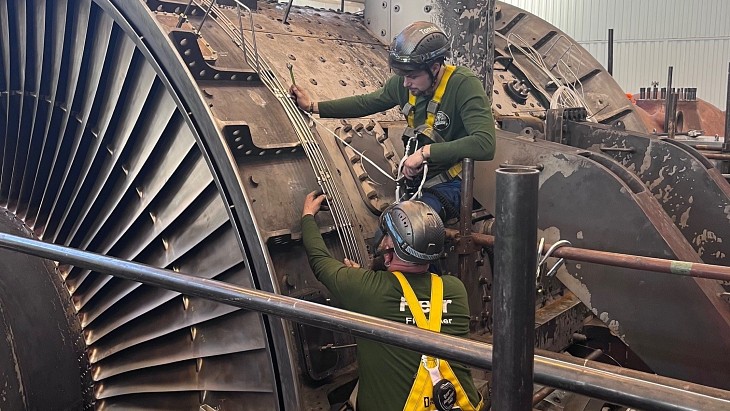
Upgraded turbine monitoring system at Temelin 2

Petr Měšťan, Director of the Temelín Nuclear Power Plant, said it was a modernisation of the monitoring system which had been used for ten years: “Thanks to the special sensors, we can monitor whether the vibration of the blades of the last impellers is within the required limits even during operation.”

Bohdan Zronek, member of the ČEZ board of directors and director of the nuclear energy division, said: “Although Temelín is a relatively young power plant, new technologies are always emerging. And if it makes sense for us from the point of view of efficiency and safety, we use them to the maximum extent. This applies to turbine diagnostics and a number of other devices.”

ČEZ says the sensors measure the rotation time of each blade, which is over a metre long – acceleration or delay in the passage of the blade then signals its vibration. The work, costing “tens of millions” of Czech Koruna (CZK10 million is USD474,000), is taking place during the current, planned shutdown of the unit.

Investment projects at Temelin – which has two VVER-1000 units which came into operation in 2000 and 2002 – will reach CZK3.8 billion (USD182 million) this year and include continued modernisation of the control system and completion of the switch to a longer fuel cycle, the company said in an announcement in January. The plan is for the plant’s units to operate for 60 or more years.

The Czech Republic gets about one-third of its electricity from nuclear generation – it also has four VVER-440 units at Dukovany, which began operating between 1985 and 1987. A CZK407 billion (USD18.6 billion) contract was signed with Korea Hydro & Nuclear Power last year for two of its APR1000 reactors near the existing Dukovany units. The aim is to start construction in 2029. There are also developing plans for small modular reactors in the country.

   

  • Related Posts

    Podcast: Sustainability and the UK’s Low Level Waste Repository

    Nuclear Waste Services’ Director of Sites and Operations, Mike Pigott, and Head of Waste Services Howard Falconer, explain the history of the site, how its operations have changed and its…

    Kazakhstan outlines localisation plans

    The Comprehensive Plan for Developing Localisation in the Nuclear Industry for 2026–2030 was developed by Kazakhstan’s Atomic Energy Agency, jointly with Kazakhstan Nuclear Power Plants LLP, interested central government agencies,…

    Have You Seen?

    Oil Slips to Two-Week Low as US and Iran Seen Moving Closer to Deal

    • May 25, 2026
    Oil Slips to Two-Week Low as US and Iran Seen Moving Closer to Deal

    What Needs to be Agreed to End the Iran War?

    • May 25, 2026
    What Needs to be Agreed to End the Iran War?

    India Raises Fuel Prices for Fourth Time as Oil Crisis Hits Consumers

    • May 25, 2026
    India Raises Fuel Prices for Fourth Time as Oil Crisis Hits Consumers

    Australia Set to Include Existing LNG Deals in Gas Reservation Scheme

    • May 25, 2026
    Australia Set to Include Existing LNG Deals in Gas Reservation Scheme

    Rubio Plays Down Imminent U.S.-Iran Deal

    • May 25, 2026
    Rubio Plays Down Imminent U.S.-Iran Deal

    Sinopec Boosts China’s Shale Oil Output

    • May 25, 2026
    Sinopec Boosts China’s Shale Oil Output

    Westfalen aims to double industrial gas capacity in Switzerland

    • May 25, 2026
    Westfalen aims to double industrial gas capacity in Switzerland

    Top Stories Of The Day: Solar Tenders, Transmission Expansion, Rooftop Policy Reforms, Corporate PPAs & More…

    • May 25, 2026
    Top Stories Of The Day: Solar Tenders, Transmission Expansion, Rooftop Policy Reforms, Corporate PPAs & More…

    Analysts Explain Oil Price Drop

    • May 25, 2026
    Analysts Explain Oil Price Drop

    UAE Showcases National Hydrogen Strategy And Clean Energy Vision At Global Hydrogen Summit

    • May 25, 2026
    UAE Showcases National Hydrogen Strategy And Clean Energy Vision At Global Hydrogen Summit