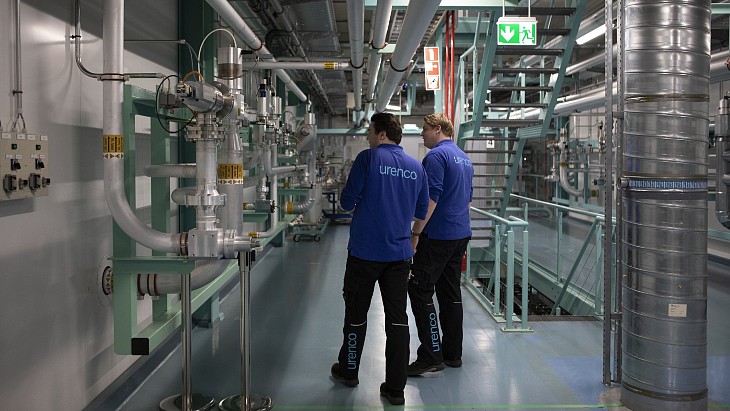
The first stage of expansion at Almelo, of about 750,000 separative work units (SWU), was announced in 2023 and is scheduled to come online in 2027. That will increase the site’s capacity by about 15%. The company is now planning a second stage, to build an additional centrifuge hall providing a similar amount of extra capacity, so in total providing 1.5 million SWU of extra capacity by 2030.
Ad Louter, Managing Director of Urenco Almelo, said: “This project is the largest buildout of new enrichment capacity undertaken so far as part of the company’s capacity expansion programme and ensures that we can offer security of supply to global customers, while providing stable and long-term employment opportunities in our region.
“We are encouraged by the actions of both utilities and governments to support the nuclear industry and the fuel supply chain specifically. We will evaluate other expansions as supported by long-term contracts. Stable government policy is also critical and a positive development in the EU has been the intention to phase out Russian nuclear material through the REPowerEU plan.”
The announcement means Urenco has globally now committed to 2.5 million SWU of new enrichment capacity, including the first two centrifuge cascades now online in Eunice, New Mexico in the USA. At its site in Gronau, Germany, the company is re-fitting an existing space with more modern centrifuge technology which will enhance the capacity of the plant.
In addition to the Almelo, Eunice and Gronau plants, Urenco also operates an enrichment facility at Capenhurst in the UK.
The nuclear fuel cycle
Unenriched, or natural, uranium contains about 0.7% of the fissile uranium-235 (U-235) isotope. (“Fissile” means it’s capable of undergoing the fission process by which energy is produced in a nuclear reactor). The rest is the non-fissile uranium-238 isotope. Most nuclear reactors need fuel containing between 3.5% and 5% U-235. This is also known as low-enriched uranium, or LEU. Advanced reactor designs that are now being developed – and many small modular reactors – will require higher enrichments still. This material, containing between 5% and 20% U-235 – is known as high-assay low-enriched uranium, or HALEU. And some reactors – for example the Canadian-designed Candu – use natural uranium as their fuel and don’t require enrichment services. But more of that later.
Enrichment increases the concentration of the fissile isotope by passing the gaseous UF6 (uranium hexafluoride) through gas centrifuges, in which a fast spinning rotor inside a vacuum casing makes use of the very slight difference in mass between the fissile and non-fissile isotopes to separate them. As the rotor spins, the concentration of molecules containing heavier, non-fissile, isotopes near the outer wall of the cylinder increases, with a corresponding increase in the concentration of molecules containing the lighter U-235 isotope towards the centre.
Enriched uranium is then reconverted from the fluoride to the oxide – a powder – for fabrication into nuclear fuel assemblies.
contains more details about the enrichment process and technology.