Friday, 30 May 2025
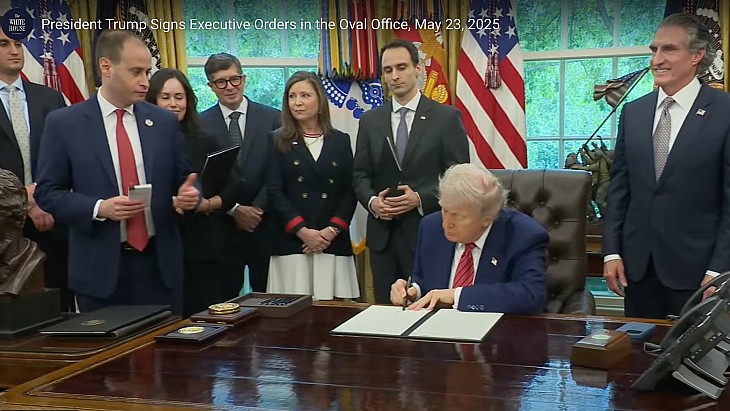
Four executive orders signed by President Donald Trump on 23 May aim to support the entire US nuclear supply chain and the ambition to quadruple the nation’s nuclear energy capacity by 2050. Three of the orders are firmly focused on reforms that will boost the civil nuclear energy sector: you can read about them in WNN’s article . The fourth one aims to ensure the rapid development, deployment, and use of advanced nuclear technologies to support national security objectives, including AI data centres at Department of Energy facilities.
Many fuel cycle companies have responded positively to the Administration’s action.
Amir Adnani, president and CEO of Texas-based Uranium Energy Corp applauded the US government’s “decisive” action, saying the orders “send the strongest signal yet that energy security and national security start with a robust domestic uranium supply chain. As the US continues to import nearly all of its nuclear fuel amid a growing global supply deficit, the Administration is positioning the nation to lead the next era of global nuclear development by rebuilding a vertically integrated fuel cycle and investing in domestic uranium production. UEC is ready to support this transformation with secure, reliable, and 100% domestic uranium supply to power the future.”
Colorado-based uranium producer Ur Energy likewise commended the Administration, saying the actions support long-term uranium demand and therefore production from the company’s Lost Creek and Shirley Basin mines. “The Executive Orders’ mandate of rapid action will result in the expansion of the domestic reactor fleet and resulting demand for uranium,” it said.
New opportunities
Global Laser Enrichment (GLE) recently began large-scale testing of the SILEX laser uranium enrichment process at its facility in North Carolina. “The administration has underscored the importance of expanding domestic conversion and enrichment capacity – priorities that align closely with GLE’s capabilities and mission,” CEO Stephen Long said. “These directives recognise the critical role of nuclear energy and a robust fuel supply chain in ensuring American energy dominance, as well as the necessary actions to accelerate deployment. Our proposed Paducah Laser Enrichment Facility is uniquely positioned to support both of these objectives, advancing innovation and US technology leadership and enhancing the nation’s energy security.”
Advanced nuclear fuel company Lightbridge Corporation said the orders represent “the most significant policy shift toward nuclear energy in decades”. It identified the provisions under the order on , which directs the Department of Energy to prioritise work to facilitate power uprates to existing reactors, as being of particular relevance to the company which is developing innovative Lightbridge Fuel for existing reactors.
“We believe enabling power uprates of up to 17% in existing reactors is one of Lightbridge Fuel’s most value-adding capabilities. We may not meet the executive order’s goal of adding five gigawatts of power uprates to existing reactors by 2030. Still, this direct policy support for power uprates aligns with the objectives of Lightbridge,” the company said.
Lightbridge President and CEO Seth Grae also pointed to potential new opportunities created in the national security sector, which could open new market segments beyond traditional utility applications, including dedicated nuclear power supply at or near data centre locations.
Advanced nuclear technology company Oklo Inc is developing fast fission power plants capable of recycling used nuclear material, and has been given access to high-assay low-enriched uranium recovered from used fuel from the Department of Energy Experimental Breeder Reactor-II, which operated at Idaho National Laboratory from 1964 to 1994, to fuel its first core. The company said the executive orders also emphasise the importance of using existing domestic nuclear fuel feedstock to jump-start early projects and strengthen national energy resilience.
“These executive orders are about enabling deployment. They show clear alignment around the need to modernise how we license, fuel, and build advanced nuclear power to meet rising demand,” Oklo co-founder and CEO Jacob DeWitte – who was present with other industry leaders at the White House for the signing ceremony – said.
Resolving the challenge
The executive orders represent a historic federal commitment to unlocking the full potential of nuclear energy, including a clear directive to develop a national policy for managing used nuclear fuel and evaluating recycling and reprocessing pathways, nuclear waste disposal technology company Deep Isolation said, signalling a shift towards enabling permanent solutions for the USA’s growing inventory of nuclear waste.
The executive orders direct the Department of Energy to bring forward national policies on the management of used fuel and high-level waste, evaluate private-sector reprocessing options, and identify disposal pathways. Deep Isolation CEO Rod Baltzer welcomed the Administration’s commitment to resolving the disposal challenge. “The Executive Orders mark a turning point for American innovation, science, and leadership. We have the tools and the technologies and, with these Executive Orders, we now have the political commitment to act. What we need next is execution,” he said.
Regulation question
The executive order on asserts that an unnecessarily slow, burdensome and risk-averse regulatory regime has stifled the US nuclear energy sector and orders the US regulator to carry out a wholesale revision of its regulations, as well as imposing an 18-month time limit for final decisions on applications to build and operate new reactors, and 12 months for applications to continue operating existing reactors.
But some commentators are questioning whether the regulatory regime – which was already undergoing reforms under the 2024 ADVANCE Act – is really the problem. Writing in , Toby Dalton, a senior fellow and co-director of the Nuclear Policy Program at the Carnegie Endowment for International Peace, and Ariel Levite, a senior fellow at the Endowment, said the orders “grossly exaggerate the delays to new deployment legitimately attributable to excessive nuclear regulation. They underestimate the addition of time to market due to limitations on workforce availability, supply chain, financing, specialty fuels and community buy-in.
“What Americans need is confidence that any nuclear power plant built and operated in the US is safe, secure and ultimately beneficial to American and host community prosperity.”
Article researched and written by WNN’s