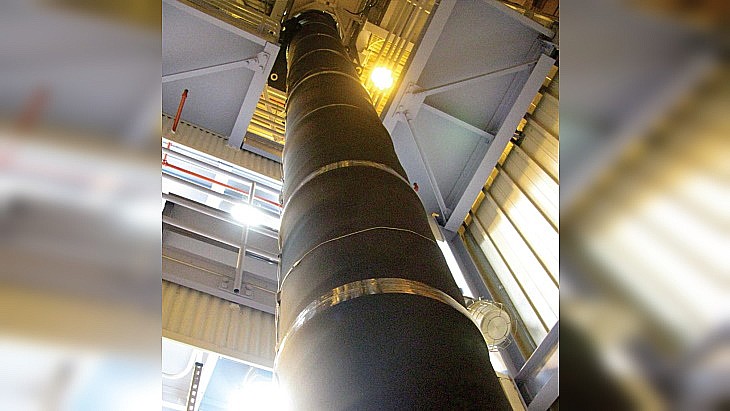
Centrus announced on 19 December that it had started manufacturing centrifuges at its centrifuge manufacturing factory in Oak Ridge, Tennessee – relying on a domestic manufacturing supply chain – to support commercial low-enriched uranium (LEU) enrichment activities at its facility at Piketon, Ohio. The first new production capacity is expected to come online in 2029.
This is part of a multi-billion-dollar uranium enrichment capacity expansion which is underpinned by funding from the Department of Energy via task orders for the production of LEU and high-assay low-enriched uranium (HALEU), private capital, commercial contracts and third-party investments.
Centrus Energy CEO and President Amir Vexler described the official start of “industrial-scale centrifuge manufacturing build for commercial LEU enrichment” as an “historic step” for the company. “We make this announcement after carefully evaluating the business’s internal and external progress as well as its future prospects and many competitive advantages. These include the significant progress in building our supply chain; the advancement across the many available avenues to acquire low-cost of capital to support our build, including imminent DOE funding announcements; and, evaluating the progress in our internal manufacturing capabilities,” he said.
The USA’s last domestically owned commercial uranium enrichment capacity, the Paducah gaseous diffusion plant in Kentucky, closed in 2013, leaving the Urenco USA (UUSA) plant at Eunice in New Mexico as the only commercial enrichment capacity in the USA – a plant using a European centrifuge design manufactured in the Netherlands. This has left the USA dependent on overseas enterprises. But with demand for nuclear power expected to grow in the coming years – and a complete ban on US imports of Russian enriched uranium from 2028 – “new domestic, US-owned uranium enrichment capacity is urgently needed and in high demand”, the company said. A fully domestic source of enriched uranium is also needed to fulfil national security missions – and Centrus says its AC100M centrifuge is the only deployment-ready US-origin enrichment technology that can currently meet that need.
The expansion programme is expected to support thousands of direct and indirect jobs in Ohio, Tennessee, and across the country.
Economic benefits
Meanwhile, a new report by Oxford Economics has found that the operations of Urenco USA contributed more than USD360 million to the US economy in 2024-2025 and supported more than 1,700 jobs in total at the UUSA plant and elsewhere in the USA. The company also purchased some USD68.6 million worth of goods and services from US suppliers.
The report, using 2024 data, was commissioned by Urenco USA to quantify its impact at the local, state, and national level as it looks to make further investments in the site in future years, including adding new capacity and constructing new facilities, the company said.
“From fuelling reliable electricity production across the country to inspiring the next generation in our local schools, Urenco USA and our employees make substantial contributions at a local, regional, and national level, as evidenced by the results seen in the Oxford Economics report,” Managing Director John Kirkpatrick said.
The study was released in the same month that Urenco USA completed its first production run of low-enriched uranium plus, or LEU+ – material enriched to 8.5% in the fissile uranium-235 isotope – and also started up a new cascade of centrifuges that are part of a programme to install 700,000 separative work units (SWU) of capacity by 2027 at the New Mexico plant.