The project is a collaboration between advanced nuclear energy company Elemental Nuclear Energy Corporation – which is developing next-generation microreactors and high-performance Brayton Cycle power generators – and the John and Marcia Price College of Engineering’s Nuclear Engineering Programme. The demonstration will involve collaboration among students and faculty from twelve universities across the USA and internationally.
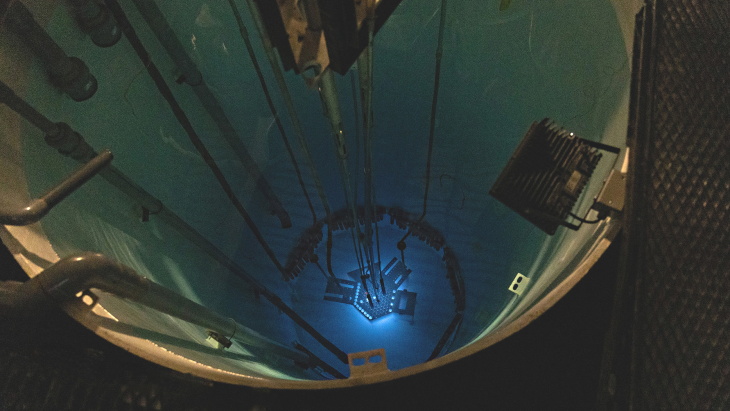
The university’s TRIGA reactor, which was installed in October 1975, is used for research purposes, The heat it produces is usually bled off by cooling systems rather than being captured to generate electricity. Elemental’s innovation is a compact, cold-helium-based power generator that pairs with low-temperature microreactors, replacing steam turbines and their large footprints.
During the experiment, the thermal energy generated by the reactor will be partially captured and converted into electricity using a compact Brayton Cycle power system. The system utilises a ‘cold’ or ‘reverse’ Brayton cycle, in which a helium working fluid is compressed, heated using reactor pool water, expanded through a turbine generator, and subsequently cooled via a cryogenic heat exchanger.
Once connected, the resulting electricity will be used to power a high-performance GPU (Graphics Processing Unit) node executing a live AI workload.
The experiment is designed as a proof-of-concept system with the following targets: thermal input from TRIGA reactor water of about 50 kW; turbine output of about 13 kW; and net electrical generation of about 2-3 kW. The system is intended to demonstrate that even small nuclear platforms can produce usable electricity sufficient to power modern computing systems.
“While the 2-3 kW output is modest compared to the hundreds-of-megawatts full-scale data centres will require, it’s a symbolic first step towards powering the future,” Elemental said.
The AI component of the experiment is supported through collaboration with the University of Utah Scientific Computing and Imaging Institute, which brings expertise in the design, development, and operation of AI infrastructure.
“This project is intended to demonstrate a powerful principle,” said Mike Luther, Founder of Elemental Nuclear. “The energy produced through nuclear fission can ultimately power the computational systems driving artificial intelligence.
“Our objective is to deliver a commercially viable nuclear microreactor by 2030–2031. Experiments like this enable us to move quickly, validate real-world systems, and build toward scalable solutions.”
TRIGA – standing for Training, Research, Isotopes General Atomics – reactors are primarily used for student training, research projects and isotope production. These reactors operate at thermal power levels from less than 0.1 to 16 megawatts, and are pulsed to 22,000 megawatts. Three generations of the pool-type reactor have been built around the world since 1960, 36 of which remain in operation today. Twelve of the 18 TRIGA reactors in the USA are located at universities.
Ted Goodell, the University of Utah’s reactor manager, said: “This will be, to our knowledge, the first time any university reactor has produced electricity, not just our own. It’s a milestone for our students, but it also shows that small, safe reactors could live at data centres, rather than in labs.”