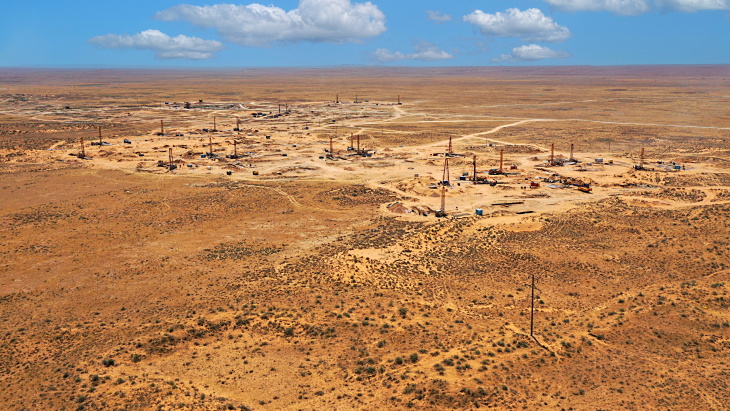
“Pilot industrial operations at the deposit began in December 2024, and over two years of active work, the Company has reached the stage of commercial production,” said Djamal Sabakhonovich Fayzullayev, General Director of Navoiyuran. “The start of ore mining at the deposit marks another step in the implementation of the company’s strategy, focused on increasing uranium production and strengthening its mineral resource base, in line with Uzbekistan’s state programme to expand uranium mining and processing volumes through 2030.
“In 2025, Navoiyuran’s production reached 7,000 tonnes of natural uranium. The Qizilkok deposit, with a projected mine life of 15 years and an annual production capacity of 1,200 tonnes of uranium, will play a key role both in supporting future production growth and in contributing to regional economic development.”
The Qizilkok prospective area – situated in the eastern part of the Central Kyzylkum Desert – comprises four licence blocks: Amantau (in the northwestern part), Myutenbay (in the northeastern part), Qizilkok (in the southeastern part), and Yuzhny (in the southern part). Under the project, all of these licence blocks are integrated into a single prospective area, Qizilkok.
The Qizilkok deposit is being developed using a low-reagent in-situ recovery oxygen technology actively advanced by Navoiyuran, which it says increases uranium recovery while reducing production costs by 2-3 times.
In-situ recovery – or ISR – is a method of mining uranium by dissolving and recovering it via wells. It is also known as in-situ leaching. Ground water fortified with a complexing agent, and often with an oxidant (such as gaseous oxygen), is introduced into the orebody to dissolve the uranium from the sandstone host. The uranium-bearing solution is pumped to the surface before the uranium is recovered and processed into yellowcake.
Navoiyuran describes Qizilkok – with mineral resources of 10,900 tU and ore reserves of 9,400 tU – as the third-largest deposit in its portfolio, following the Sugrali (20,800 tU of reserves) and Uchkuduk (14,800 tU of reserves) deposits. It has a project mine life of 15 years, with further potential for expansion to the north.
Uzbekistan’s estimated uranium output in 2024 was 4,000 tU, according to information from World Nuclear Association, making it the fifth largest uranium producer in the world behind Kazakhstan, Canada, Namibia and Australia. Navoiyuran says it is currently the sixth-largest uranium producer globally, operating 43 uranium deposits with a mineral resource base of 151,100 tU, including 96,600 tonnes of JORC-compliant ore reserves.