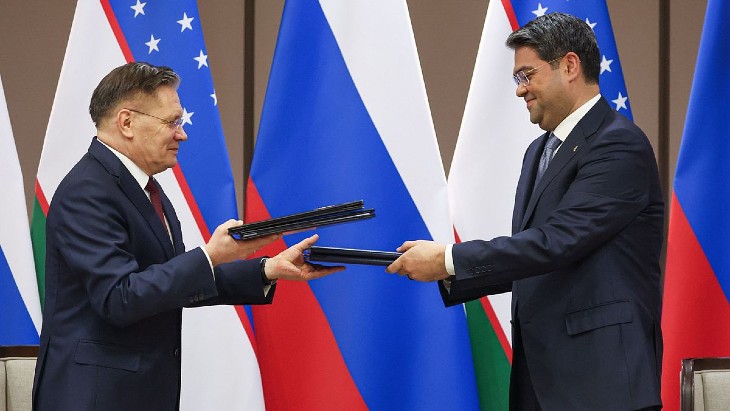
The roadmap, signed by Rosatom Director General Alexey Likhachev and Uzatom Director Azim Akhmedkhadzhaev, “covers all key areas of cooperation on the nuclear power plant construction project, including personnel training, public awareness of modern nuclear technologies, and the creation of a future ‘nuclear city’ at the plant”.
A supplemental agreement to the contract for the new nuclear power plant covers the decision to change its contents to two gigawatt-scale VVER-1000 units and two 55 MWe RITM-200N small modular reactors (SMRs). The original plan had been for the plant to feature six of the SMRs – the new design will mean a capacity of more than 2,100 MWe, compared with the previous 330 MWe.
(Image: Rosatom)
The two countries’ presidents spoke on the phone on Tuesday, noting the signing of the roadmap and the progress being made for the first SMR unit at the site, in the Jizzakh region.
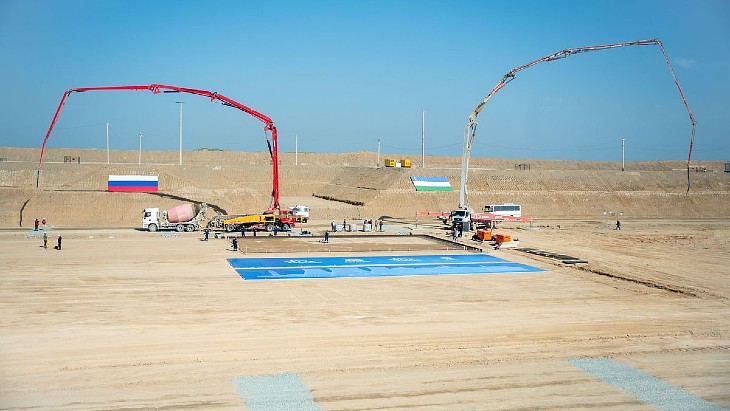
Rosatom said that, following the receipt of the necessary permissions to use the site for the two SMRs, concrete work had begun at the site, saying that “approximately 900 cubic metres will be poured during the concrete foundation work for the reactor building, due for completion in April”. It said that this foundation will then be levelled and waterproofed before “the pouring of the first concrete for the reactor building’s foundation slab”.
(Image: Rosatom)
Alexey Likhachev, Rosatom Director General, said: “The signing of the roadmap and agreement for the construction of the integrated nuclear power plant, and the subsequent commencement of concrete work at the site, mark Uzbekistan’s emergence as a leader in global nuclear energy. The country is launching a unique project that will contribute to socioeconomic growth and strengthen its technological sovereignty for decades to come.”
Once it is fully operational, the plant will generate approximately 17.2 billion kWh per year, about 14% of Uzbekistan’s total energy requirements.
Background
A contract signed in May 2024, during a visit to the country by Russian President Vladimir Putin, was for the construction of a 330 MW capacity nuclear power plant featuring six units of the RITM-200N water-cooled small modular reactor, which is adapted from nuclear-powered icebreakers’ technology, with thermal power of 190 MW or 55 MWe and with an intended service life of 60 years. The first unit was scheduled to go critical in late 2029 with units commissioned one by one.
It was the first export order for Russia’s SMR. The first land-based version is currently being built in Yakut in Russia, with the launch of the first unit scheduled to take place in 2027.
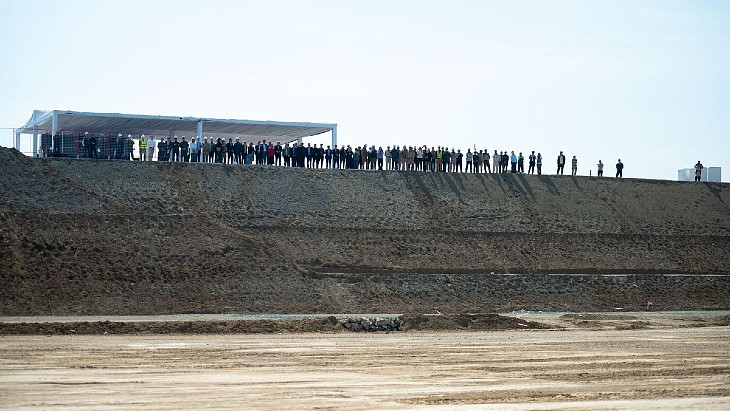
A ceremony was held at the site, where a giant pit has been prepared (Image: Rosatom)
An agreement signed at the end of September 2025 during World Atomic Week in Moscow multiplied the capacity of what had previously been proposed, with the plant plan switched to feature two large units – VVER-1000s with an output each of 1 GW – plus two 55 MW RITM-200N SMRs.
Excavation work began in October for the pit for the first of the SMRs at the site. About 1.5 million cubic metres of soil were excavated during the digging of a pit 13 metres deep for the RITM-200N, with engineering surveys and design and preparatory works also taking place.