More than 20,000 people from 100+ countries attended the four-day gathering in Russia. As part of it, the Uzbekistan agreement was signed by Andrey Rozhdestvin, Director General of Rosatom Energy Projects Company, and Abdujamil Kalmuratov, Head of the Directorate for the Construction of a Nuclear Power Plant State Enterprise.
The two sides agreed a supplement to the Agreement on Key Terms for Project Implementation which sees them agree that the project – which had been planned to feature up to six small modular reactors (SMRs) – will now have its capacity increased and feature two VVER-1000 units and two 55 MW SMRs. They also signed an agreement covering the key terms for future fuel supply contracts.
Azim Akhmedkhadjaev, Director of Uzatom, said: “In the very heart of Uzbekistan, in the Jizzah region, we are creating an unprecedented energy project. By becoming pioneers in the development of Central Asia’s nuclear energy, we are not just building the first station in the region – we are the first to create an innovative solution for the future. Our project is a bold combination of advanced small modular reactor technologies and the time-tested solutions of traditional high-capacity nuclear power.”
Alexey Likhachev, Rosatom Director General, said the “signing marks a new stage in the development of relations between Rosatom and Uzbekistan … Uzbekistan will become the first country in the world to build an integrated nuclear power plant, where both a modern small-scale nuclear power plant and a large-scale nuclear power plant will be operated simultaneously on a single site”.
Uzbekistan says that it aims to have completed the design for the SMR project by the end of this year so that the “main phase of its implementation can begin in 2026”.
BRICS gathering
The BRICS Nuclear Energy Platform has been established with the goal of “strengthening cooperation at the corporate level aimed at promoting nuclear energy as an environmentally friendly source of energy” among its members and partner countries.
(Image: Rosatom)
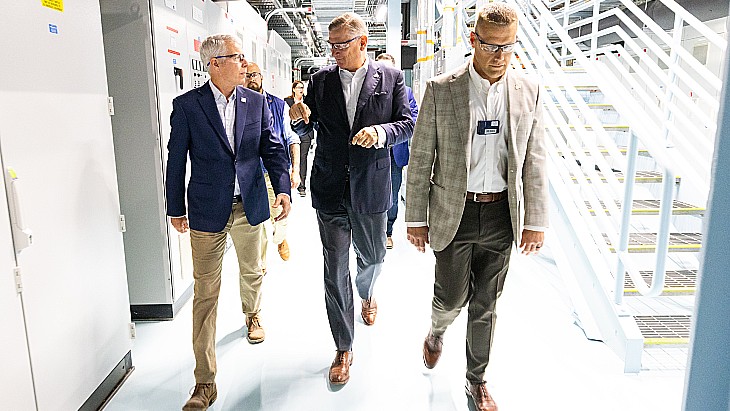
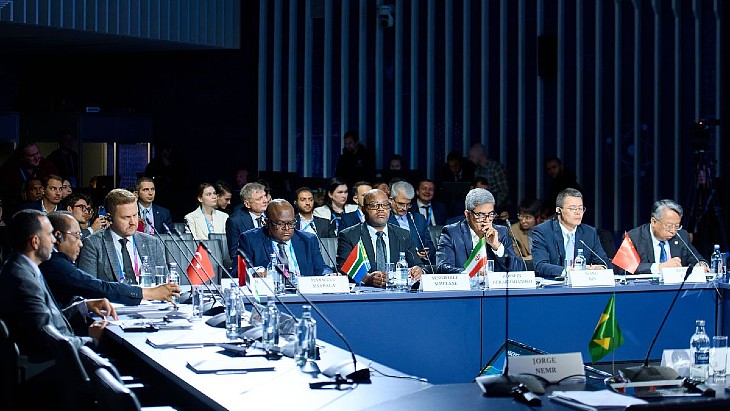
As part of World Atomic Week, the annual conference of the platform was held (see picture above), featuring attendees from Brazil, Vietnam, Egypt, Iran, China, South Africa, the UAE, Ethiopia, Turkey, and the ASEAN Energy Hub.
Among those who spoke at the event were Mikhail Chudakov, Deputy Director General and Head of the IAEA Department of Nuclear Energy; Sama Bilbao y León, Director General of World Nuclear Association; Razib Dawood, Executive Director of the ASEAN Energy Centre; and Julio Lopes, leader of the Brazilian Parliamentary Front for Technology and Nuclear Activities.
Bilbao y León’s message was that having a united approach and bold mind-set was crucial to mobilise supply chains. She said that the industry “is often reminded that our risks transcend national borders, that ‘an accident anywhere is an accident everywhere’, but the other side of risk is opportunity and the opportunity transcends borders too. I would remind the global industry that a successful nuclear project anywhere is a success for nuclear everywhere. The more we demonstrate we can deliver, the more opportunities we will have for success”.
The Chief Coordinator of the BRICS Nuclear Energy Platform, Elsie Pule, said that BRICS and its partner countries account for almost one-third of operating nuclear power plants and more than 70% of power units under construction, and by 2030, will account for at least two-thirds of the global nuclear fleet’s growth.
During the event its first strategic document was approved, which sets out its key areas of work, including developing human resources, attracting finance, supply chain sustainability, nuclear fuel cycle technologies and public acceptance.
New nuclear projects
Among other agreements announced was a memorandum of understanding between Rosatom and Vietnam Electricity Corporation subsidiaries which “laid the foundation for cooperation between the parties within the framework of the Ninh Thuan-1 NPP project”.
Rosatom said “the document aims to consolidate efforts to update the feasibility study and site documentation for Vietnam’s first nuclear power plant, Ninh Thuan-1. The memorandum also provides for deeper cooperation in developing power grid and logistics infrastructure, training specialists, and other areas”.
There was also a session focused on the potential of floating nuclear power plants – which included government and business representatives from Thailand, Indonesia, Myanmar, the Philippines, Ghana and South Africa.
Andrey Nikipelov, Deputy Director General for Mechanical Engineering and Industrial Solutions at Rosatom , noted thatmany countries see the enormous potential of floating power units: “They’re scalable, allowing you to generate as much energy as you need … they can be moved wherever and whenever the customer needs them. We provide ready-made energy and take on all the complex tasks of generating it ourselves.”
There were a series of other agreements, and an address by Russia’s President Vladimir Putin