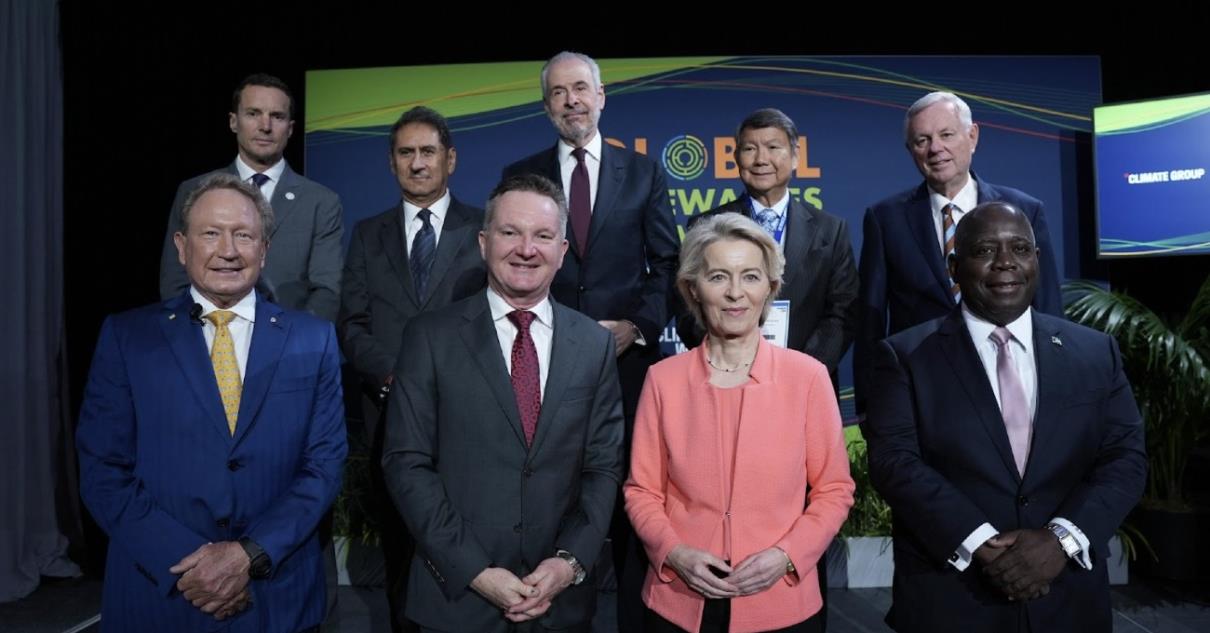
A diverse group of government leaders, private sector executives, financiers, and civil society representatives came together in New York for the High-Level Session on Renewable Energy Abundance, one of the flagship events of Climate Week NYC and the official opening of the Global Renewables Summit. The session was held at a pivotal moment in the global energy transition, just days ahead of the UN Climate Summit, where countries are expected to present their updated national climate action plans (NDCs).
The gathering highlighted the collective commitment of governments and industry to accelerate the development of zero-emissions infrastructure, which will reshape economies and societies worldwide. Participants stressed that renewable energy technologies are no longer a distant vision but are already reducing costs for businesses and communities while creating opportunities for innovation, competitiveness, and long-term resilience.
Key leaders who addressed the event included Ursula von der Leyen, President of the European Commission; William Ruto, President of Kenya; Philip Davis, Prime Minister of the Bahamas; Chris Bowen, Australia’s Minister for Climate Change and Energy; Andrew Forrest, Founder and Executive Chairman of Fortescue; Bruce Douglas, CEO and Founder of the Global Renewables Alliance; and Mike Rann, Chair of the Board of Climate Group.
Ursula von der Leyen noted that 2024 saw nearly two trillion dollars invested in clean energy, with spending on renewables now outpacing fossil fuels by a factor of two to one. She underlined that while the economic case for renewables is strong, momentum alone is insufficient, and decisive action is required. She called on governments to create enabling regulatory environments and on businesses and investors to commit their capital, innovation, and technology to areas where the impact would be greatest. According to her, renewable energy is not only about climate mitigation but also about energy security and economic prosperity.
Prime Minister Philip Davis of the Bahamas emphasised the need to frame renewable energy as a driver of prosperity rather than sacrifice. He argued that the narrative around clean energy should highlight opportunities, not constraints, and stressed that every solar panel installed, every regulation reformed, and every upgraded grid contributes to a more abundant and secure energy future. He urged global leaders to focus on progress over perfection, noting that collaboration strengthens the chances of success.
The session also explored how the global economy is shifting from an era of energy scarcity to one defined by abundance. Leaders discussed how renewable energy and electrification will serve as the foundation for prosperity, productivity, and competitiveness in the years ahead. They agreed that a clean energy system can simultaneously deliver affordability, security, and sustainability, creating widespread economic and social benefits.
Francesco La Camera, Director-General of the International Renewable Energy Agency (IRENA), noted that investments in renewables have grown steadily by 14 percent annually since 2018 despite global challenges such as pandemics and inflation. However, he pointed out that emerging markets and developing economies still receive less than 10 percent of energy transition financing, despite accounting for a third of global GDP. He urged global leaders to place equity and inclusivity at the core of the transition as the world moves toward the target of tripling renewable energy capacity by 2030, as agreed under the UAE Consensus.
Bruce Douglas, CEO of the Global Renewables Alliance, reinforced that phasing out fossil fuels while building renewable energy abundance is the only path to long-term prosperity, stability, and security. He urged immediate collective action to accelerate this transformation. Similarly, Ambassador André Corrêa do Lago, President-Designate of COP30, highlighted the growing integration of renewables with broader agendas such as energy justice, independence, and affordability, stressing how simpler technologies and scalable infrastructure can drive economic growth.
For households and communities, the shift to renewable energy will mean lower electricity bills, greater energy independence, and new job opportunities. For industries, it offers a platform to power innovation in areas such as advanced manufacturing and artificial intelligence, supported by abundant clean energy resources. The High-Level Session, jointly organised by Climate Group, Fortescue, and the Global Renewables Alliance, reinforced the message that renewable energy abundance is not just an environmental goal but a central driver of economic transformation and global prosperity.
Subscribe to get the latest posts sent to your email.