Monday, 14 April 2025
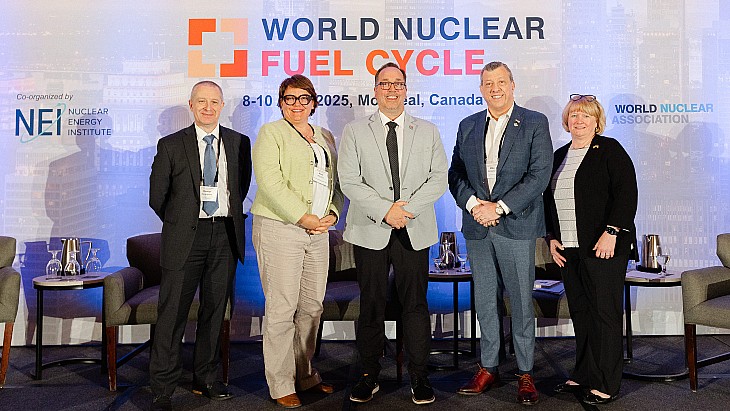
Transport has always faced challenges with too few ports and carriers willing to accept Class 7 radioactive materials, said panel moderator and Energy Resources International President Eileen Supko, who is also the World Nuclear Transport Institute’s principal representative for North America. (Radioactive materials are Class 7 materials under ).
Panelist George Kargopolov, transportation and special projects director of Montreal-based CIS Navigation agreed. The company operates a fleet of six ships transporting radioactive and nuclear materials including radioisotopes such as cobalt-60 and natural uranium, and has provided nuclear material transport services for almost three decades.
With more and more nuclear power plants around the world, the demand for nuclear transport is growing, but there are not many carriers that are willing to accept nuclear materials for transportation and there are few ports, especially in the USA, that are capable and willing to handle nuclear materials, he said: “The industry is expanding, but the shipping capacity is not.”
He identified four key challenges for nuclear sea transportation: nuclear liability concerns; stowage limitations; port acceptance issues; and political and regulatory challenges, specifically proposals by the USA to levy charges on Chinese-built or linked ships for each port call they make in the USA (known as USTR Section 301). “Nuclear materials carriers are niche carriers, and they will be definitely affected if the [proposed] flat fee of USD1.5 million [per port call] will be applied,” he said.
Kurtis Hinz, president and CEO of Canadian headquartered transporter TAM International, said USTR Section 301 tariffs could lead to a further restrictions and limitations on carriers of Class 7 materials and result in “rate volatility” for the transport of such materials.
For every Chinese-built vessel in its fleet, the shipping line will be charged up to USD1.5 million per port call, Hinz said. “So let’s say the vessel calls into the west coast of the US. That’s USD1.5 million in LA, USD1.5 million in Oakland, USD1.5 million in Seattle tagged on to that vessel,” he said.
“If you’re a big carrier that has 15,000 containers on it, you can spread that cost out. If you’re chartering for small amounts of uranium ore, EUP (enriched uranium product) or things like that, that number hits pretty hard,” he said.
“At the end of the day, we are the last in line on those liner services to try and move material. We have to make alliances … but they will restrict their capacities to make sure they’re running as efficiently into the places they work.”
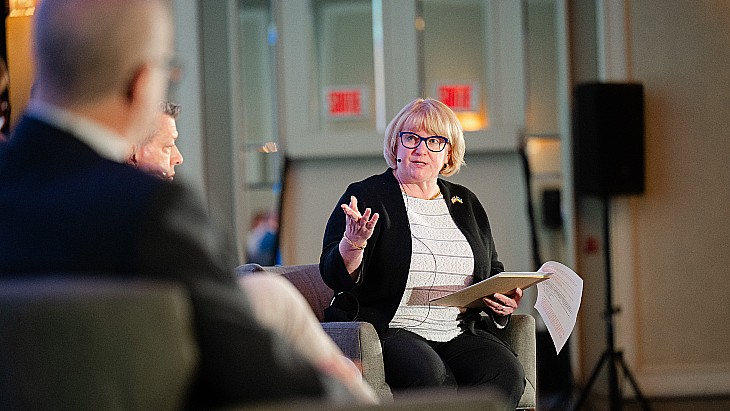
Eileen Supko (Image: World Nuclear Association/Sonia Bourdon)
New challenges
Transporters of Class 7 materials are facing growing risks of delays and denial of shipments. Anne Presta, head of Orano Nuclear Packages and Services’ Institutional Relations Unit, said Orano carries out around 6000 transports per year of nuclear and radioactive materials, operating by all modes of transport. It particularly favours rail, and has long-term partnerships with shipping and airline companies.
Keeping the routes open for nuclear materials is a fundamental and crucial challenge for the nuclear industry, and the current geopolitical situation means transporters have to monitor and navigate changing international sanctions. Another key challenge is the emergence of small modular reactor and advanced modular reactor technology, which rely on fuels with higher levels of uranium enrichment (high-assay low-enriched uranium, or HALEU) which will require the development of suitable transport solutions as well as bringing heightened security considerations.
Nuclear and radioactive materials are routinely shipped around the world for medical, industrial and energy purposes, so delays and denials of nuclear and radioactive shipments can have a significant impact. As fuel cycle transport flows have developed and carriers have opened more routes, the risk of delays and denials is growing, and is becoming a major challenge faced by carriers, Presta said.
The concept of denial and delay of shipments of radioactive sources emerged some 20 years ago, with delays to the transport of radioactive sources for medical use meaning a loss in efficacy by the time they reached their destination.
A denial of shipment is the refusal of a port, an airport, or a carrier to accept a shipment, even if it is fully compliant with all regulations, Presta explained, and is an everyday occurrence all over the world. The International Atomic Energy Agency (IAEA) is working to address this issue through its Denial of Shipment Working Group, and Presta called for a “maximum number” of IAEA Member States to join the agency’s forthcoming joint statement on the initiative to raise global awareness of the issue.
The initiative has also established a network of National Focal Points to monitor denials and to advise or help a carrier faced with a denial of shipment. Presta is the IAEA’s National Focal Point for France.
Lynch pin
Michael McMahon is vice president of Transportation and Strategic Projects at NAC International, part of the Kanadevia Corporation (formerly Hitachi Zosen Corporation), with more than 30 years’ experience in nuclear materials transportation services, especially in the back-end of the fuel cycle.
“I would say without transportation, there’s no nuclear because the materials have to get from where they are to where they need to be. And that’s not the same place. Without that lynch pin, you really don’t have an industry,” he said.
He also highlighted HALEU fuels as a challenge for the transport sector. Current volumes of HALEU requiring transport are low but this is set to change and become an area of concern over the coming years, he said. The packages that exist today for shipping HALEU are geared towards smaller quantities and are not going to be economically efficient for larger demand in future.
“It still takes time and money to get a new package designed now that is going to economically address this market,” he said.
Back-end transport issues should not be forgotten, he added, describing the back-end of the fuel cycle as an “intractable” issue that could hinder nuclear expansion plans: “In the US, one of the big challenges is that no matter what solution you have – interim storage or repository – you’re gonna have to transport hundreds of thousands of tonnes of spent fuel from somewhere to somewhere else … we’re gonna need to address that.
Statistics show that “transportation is absolutely the safest thing we do in nuclear right now”, McMahon said, but a gap between public perception of risks versus the reality of the thousands of nuclear fuel transports completed safely every year present a potential barrier to new nuclear plans. “I think this is going to be a big challenge for us,” he said, calling for a demonstration of the safety of these future transports. “That would be a key aspect for us.”
World Nuclear Fuel Cycle 2025, co-organised by the Nuclear Energy Institute and World Nuclear Association, took place in Montreal, Canada on 9-10 April.