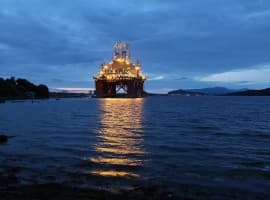
The Johan Castberg oilfield in the Barents Sea has reached full capacity of 220,000 barrels per day (bpd), operator Equinor said on Friday, noting that peak capacity has been reached just three months after the field in Norway’s Arctic waters came on stream.
Seventeen of a total of 30 wells have now been completed. The wells that have come on stream are producing as expected, Equinor said.
At the end of March, Equinor started up the Johan Castberg oilfield, following several months of delays due to inclement winter weather in the waters of Norway’s Arctic.
The project is expected to recoup the $8 billion investment in less than two years, according to the Norwegian energy major.
As Norway’s newest oilfield, Johan Castberg, is now on stream, it will produce crude for 30 years, boost Norway’s oil exports, and bolster the role of Western Europe’s biggest oil and gas producer as a reliable and long-term supplier of energy, Equinor said.
Recoverable volumes at Johan Castberg are estimated at between 450 and 650 million barrels of oil.
Equinor aims to increase the reserves at the major oilfield by between 250-550 million barrels, Kjetil Hove, Equinor’s executive vice president for Exploration & Production Norway, said on Friday.
“Johan Castberg represents a gamechanger for the importance of the Barents Sea for Norway’s future as an energy nation,” Hove added.
“We are already planning six new wells to extend plateau production. The Isflak project will be a rapid field development with an investment decision at the end of the year and start-up in 2028,” the executive said.
Equinor also plans to drill one or two exploration wells annually near Johan Castberg.
Norway expects its oil liquids production to rise by 5.2% in 2025 from 2024, also thanks to the start-up of Johan Castberg.
Yet, further exploration efforts and new discoveries would be crucial to slowing the expected decline in Norway’s oil and gas production in the 2030s, the authorities of Western Europe’s largest oil and gas producer have said in recent years.
By Tsvetana Paraskova for Oilprice.com
More Top Reads From Oilprice.com
- Chinese Firm Secures Key Gas Block in Algeria
- Middle East Conflict Sparks Exodus of Foreign Oil Personnel
- Chevron Explores Sale of Singapore Refinery Stake