Friday, 29 November 2024
_39136.jpg)
Criticality benchmarks are essential to nuclear design and safety evaluations required by the industry and regulatory bodies, but there are very few benchmarks that use high assay low-enriched uranium (HALEU). The US Department of Energy (DOE) and Nuclear Regulatory Commission are collaborating on the development of criticality data for HALEU: in August, the DOE awarded USD17 million of funding to 16 projects to help develop public data and criticality benchmarks related to the use, storage, and transportation of HALEU fuels.
The Deimos criticality demonstration, funded by Los Alamos National Laboratory’s Laboratory Directed Research and Development programme, took place at the National Criticality Experiments Research Center at the Nevada National Security Site. The centre has four critical experiment machines and is the only general-purpose critical experiments facility in the USA equipped to conduct experiments on fissionable material at or near criticality.
One of the critical assembly machines at the centre was modified to accommodate a new graphite core and ‘cups’ to hold HALEU-based fuel pellets containing TRISO (tri-structural isotropic) fuel particles. After demonstrating criticality of the system, the experiment was then measured at room temperature and heated to more than 200° Fahrenheit (93.3° Celsius) to generate new criticality safety data on HALEU fuel.
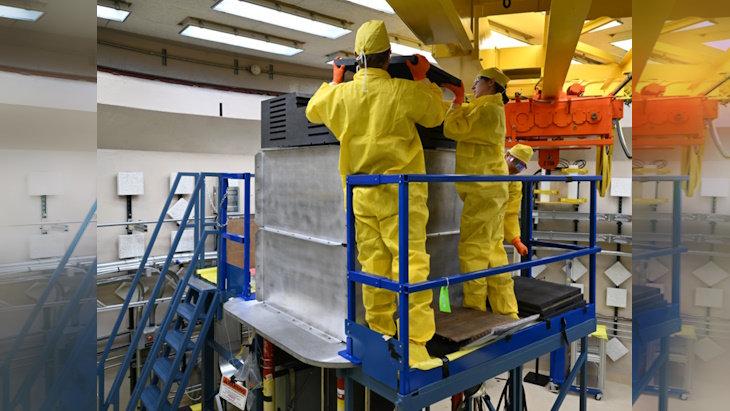 Assembling the Deimos experiment (Image: Department of Energy (DOE))
“The Deimos experiment is an important step towards deploying HALEU-fuelled nuclear reactors,” said Los Alamos National Laboratory (LANL) Programme Manager for Nuclear Energy Chris Stanek said. “We are excited and proud to make use of unique LANL capabilities to advance the nation’s advanced reactor goals, and we look forward to future experiments that Deimos enables.”
Many advanced reactors will require HALEU to achieve smaller designs, longer operating cycles, and increased efficiencies over existing nuclear technologies. Data developed from the projects funded through the will be made publicly available to enable efficient future design and safety reviews and help the nuclear industry develop new and novel solutions to address data gaps.