Tuesday, 1 July 2025
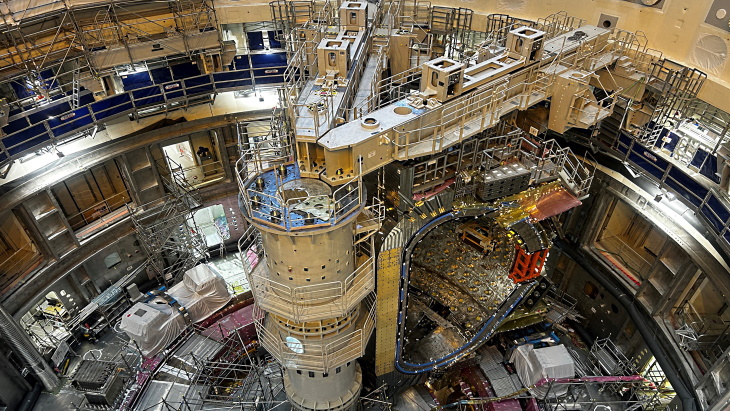
Under the contract, Westinghouse will be responsible for completing the vacuum vessel which is the tokamak fusion device’s most critical component: a hermetically sealed, double-walled steel container that will house the fusion plasma. When all the vacuum vessel sectors are in place, Westinghouse will start the most intensive stage of ITER assembly: simultaneously welding the nine sectors to form a single, circular ring-shaped chamber (also known as a torus).
“ITER is pleased to have Westinghouse Electric Company taking on this significant role in our first-of-a kind project,” said ITER Director-General Pietro Barabaschi. “With decades of leadership in nuclear power plant design and construction, we are confident that Westinghouse will be able to apply its remarkable expertise to the assembly of the ITER Tokamak.”
Westinghouse Interim CEO Dan Sumner added: “Westinghouse has always been at the forefront of energy innovation, and we are proud to work with ITER on this breakthrough initiative that could ensure energy security for generations to come. Our expert teams look forward to bringing our world-class capabilities and expertise to the completion of this important project.”
Westinghouse has collaborated with ITER for more than a decade and has played a key role in the manufacturing of key parts for the ITER vacuum vessel, including the manufacturing of five vacuum vessel sectors in cooperation with its partners in the AMW consortium, Italy’s Ansaldo Nucleare and Walter Tosto. Westinghouse said its participation involved developing advanced fabrication techniques and collaborating with global partners to meet ITER’s high-quality requirements.
ITER is a major international project to build a tokamak fusion device designed to prove the feasibility of fusion as a large-scale and carbon-free source of energy. The goal of ITER is to operate at 500 MW (for at least 400 seconds continuously) with 50 MW of plasma heating power input. It appears that an additional 300 MWe of electricity input may be required in operation. No electricity will be generated at ITER.
Thirty-five nations are collaborating to build ITER – the European Union is contributing almost half of the cost of its construction, while the other six members (China, India, Japan, South Korea, Russia and the USA) are contributing equally to the rest. Construction began in 2010 and the original 2018 first plasma target date was put back to 2025 by the ITER council in 2016. However, in June last year, a revamped project plan was announced which aims for “a scientifically and technically robust initial phase of operations, including deuterium-deuterium fusion operation in 2035 followed by full magnetic energy and plasma current operation”.