Friday, 4 July 2025
EDF can operate its 1300 MWe capacity reactors beyond their original 40-year lifespan provided that necessary upgrades are carried out, the French Nuclear Safety and Radiation Protection Authority has decided.
_41821.jpg)
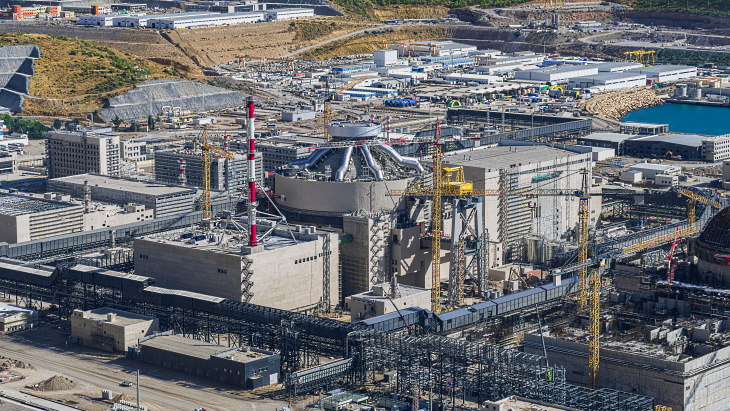
EDF operates four pressurised water reactor designs, known as the 900 MWe, the 1300 MWe, the 1450 MWe N4 and the 1620 MWe EPR. Its 32 operating 900 MWe reactors came into commercial operation between 1977 and 1988, while its 20 1300 MWe units started up between 1985 and 1993. The four N4 reactors were connected to the grid between 1984 and 1991. The Flamanville 3 EPR was connected to the grid in December last year.
In France, the authorisation to create a nuclear facility is issued by the government, after consulting the Nuclear Safety and Radiation Protection Authority (ASNR). This authorisation is issued without time limit and a thorough review of the facility, called a ‘periodic review’, is carried out every ten years to assess the conditions for the continued operation of the facility for the following ten years.
The ASNR has now determined that the 1300 MW units can continue operating beyond their fourth periodic review, conducted after 40 years of operation.
ASNR noted the fourth periodic safety review of the 1300 MWe reactors is “of particular importance since, when certain reactor equipment was designed, an assumption of 40 years of operation was adopted. Continuation beyond this period requires an update of the design studies or replacement of equipment”.
It said: “The ASNR considers that all the provisions provided for by EDF and those it prescribes open up the prospect of continued operation of these reactors for the ten years following their fourth periodic review.”
The provisions planned by EDF as part of the generic phase of the fourth periodic review of the 1300 MWe reactors were the subject of a national consultation from 18 January to 30 September 2024. The ASNR also consulted the public, via its website, on its draft decision between 16 May and 15 June 2025
In its decision, the ASNR prescribes the implementation of the major safety improvements planned by EDF, as well as the additional provisions it considers necessary to achieve the objectives of the review.
“This decision closes the so-called generic phase of the review, which concerns the studies and modifications of the facilities common to all 1300 MWe reactors, which are designed on a similar model,” ASNR noted. “It is accompanied by a letter formulating additional requests on subjects presenting lesser stakes.”
The regulator said the improvements and measures will be applied to each reactor individually during their fourth periodic safety reviews, scheduled to run until 2040. These reviews will take the particularities of each facility into account, it said. The measures planned by EDF for each reactor will be subject to a public inquiry.
ASNR requires EDF to report annually on the actions implemented to meet the requirements and their deadlines, and also on the industrial capacity of both EDF and its outside contractors to complete the modifications of the facilities within the set timeframes. The regulator requires that this information be made public.
According to a Reuters report, EDF expects to spend EUR6 billion (USD7 billion) on extending the life of the 1300 MWe reactors.
In February 2021, France’s nuclear safety regulator set the conditions for the continued operation of EDF’s 900 MWe reactors beyond 40 years. In August 2023, unit 1 of the Tricastin nuclear power plant in southern France became the first French power reactor licensed to operate beyond 40 years.