Tuesday, 15 July 2025
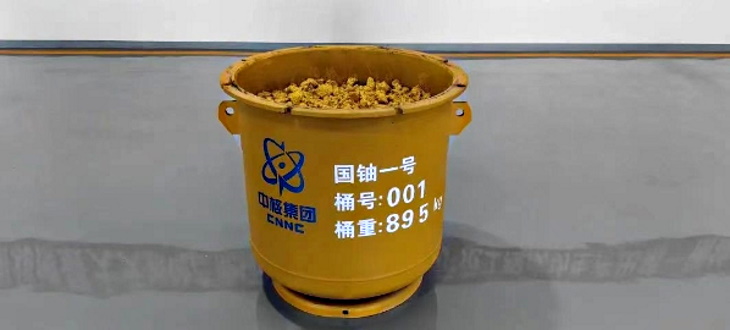
Exactly one year after construction began, China has produced its first barrel of natural uranium from its largest domestic project – the National Uranium No.1 demonstration project – in Ordos in the Inner Mongolia Autonomous Region.
_37300.jpg)
China National Nuclear Corporation (CNNC) broke ground for the project on 12 July 2024. The project integrates automation, remote centralised control and big data analysis. It uses CO2 and O2 in-situ recovery (also known as in-situ leaching), where uranium is extracted through a closed-loop circulation of the uranium solution without lifting the ores to the surface for processing – a technique said to avoid water, gas and solid wastes and minimise carbon emissions.
CNNC has now announced that the project successfully produced the first barrel of uranium products on 12 July.
(Image: CNNC)
“As the largest natural uranium production capacity project in China’s nuclear and mining industry in the past 70 years, the successful production of the first barrel of uranium marks that China’s uranium resource development has officially entered a new era of green, safe, intelligent and efficient,” CNNC said. “After completion, it will provide a solid resource guarantee for national energy security and nuclear industry development, and will also greatly enhance the international competitiveness of China’s natural uranium industry.”
CNNC noted that in the past, China’s uranium development was mainly concentrated in volcanic and granite uranium mines in the south. However, over the past two decades, major breakthroughs have been made in the prospecting of sandstone uranium mines in the north. In 2023, China released the top ten uranium prospecting results, predicting more than 2.8 million tonnes of uranium resources. The main uranium resources are concentrated in the sandstone uranium mines in the north, among which the Ordos Basin has become the country’s largest uranium resource base.
The technology used at the National Uranium No.1 project will be “fully applied and accelerated to the development of uranium resources in China’s northern basins such as Songliao, Erlian, Ordos, and Yili, supporting the construction of a number of new uranium mining bases and fully guaranteeing the demand for uranium resources for nuclear energy development,” CNNC said. “In the future, the National Uranium No.1 technology will ‘go abroad’ and be promoted to uranium mines around the world to ensure the safe and orderly development of global nuclear power.”
“This demonstration project is a major achievement in China’s third-generation uranium mining and processing technology,” said Yuan Xu, chairman of CNNC subsidiary China National Uranium Corporation.
The project is part of China’s nuclear energy development plan, with natural uranium being the basis of the nuclear fuel cycle, and with demand forecast to increase as nuclear energy capacity expands across the world.
China currently has 58 operable reactors providing capacity of 56.93 GWe. There are a further 32 reactors under construction which will provide a further 34.2 GWe of capacity and there are dozens more at the planning or proposed stage. According to World Nuclear Association’s information paper on China’s nuclear fuel cycle, China aims to produce one-third of its uranium domestically, obtain one-third through foreign equity in mines and joint ventures in other countries and to purchase one-third on the open market.