

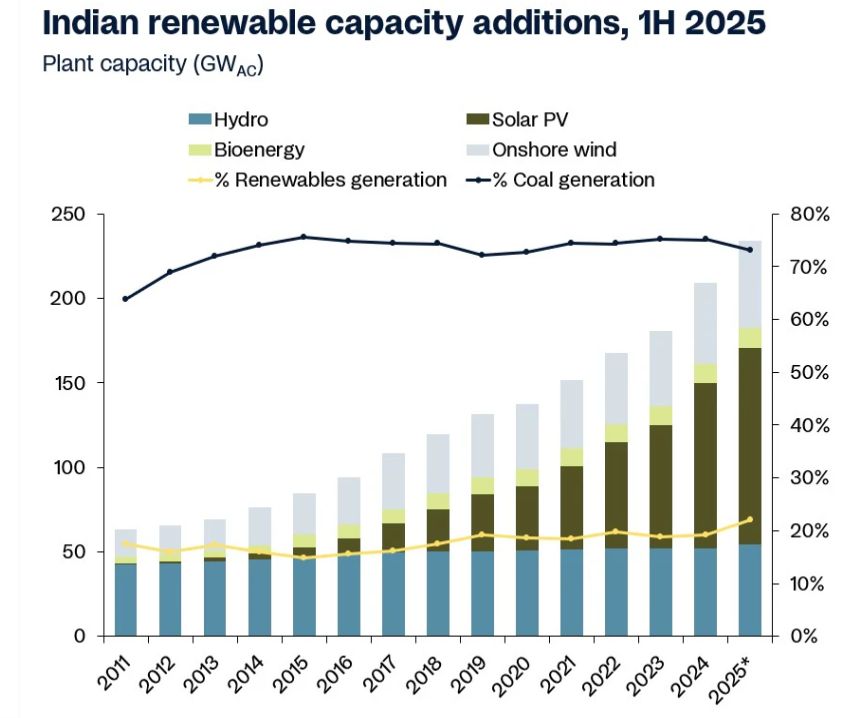
While India celebrates a record-breaking 22 GW of renewable energy capacity additions in the first half of 2025—a 57% increase from the same period last year—the broader energy landscape reveals a more complex and dual-track strategy. The country’s clean energy progress is impressive, but it coexists with aggressive expansion plans for coal-fired power, raising doubts about whether India is truly transitioning or merely diversifying its energy mix.
Driven by the upcoming Interstate Transmission System (ISTS) charge waiver, solar developers rushed to commission 18.4 GW of new capacity. Wind contributed 3.5 GW, while bioenergy added a modest 250 MW. This six-month surge is India’s most ambitious to date. Still, fossil fuels—particularly coal—continue to supply nearly 75% of electricity generated in the first half of 2025.
Although India now boasts 234 GW of clean energy capacity, including hydropower, emissions reduction progress is tempered by a planned 80 GW expansion in coal-based thermal capacity. This signals a power sector strategy focused more on reliability and capacity buildout than rapid decarbonization.
“India is not undergoing a true energy transition,” said Sushma Jaganath, Vice President of Renewables & Power Research at Rystad Energy. “It is strengthening both renewable and fossil generation to meet surging demand. Without affordability, storage, and grid improvements, coal will remain entrenched in India’s electrification roadmap.”
Amid the renewable growth, battery energy storage systems (BESS) emerged as a critical pillar for integrating variable clean energy into the grid. India awarded 5.4 GW of collocated solar-BESS and 2.2 GW of standalone BESS in the first half of 2025—the highest on record. With average quoted tariffs declining to INR 4,000/MWh for standalone BESS and INR 3,208/MWh for solar-BESS, storage is becoming more economically viable.
Leading corporates diversified their portfolios:
- Jindal Group secured 990 MW of solar + BESS
- NTPC and ReNew won 900 MW each
- JSW Energy led in standalone BESS with 625 MW
- Reliance Power and Adani Green followed closely with integrated project wins
Adani’s shift toward BESS-integrated assets signals a strategic pivot from its earlier focus on standalone solar and wind.
Western and southern India continue to lead renewable deployments:
- Rajasthan tops the list with 37.4 GW installed, driven by vast solar capacity (32 GW) and wind (5.2 GW)
- Gujarat follows with 35.5 GW, including 13.8 GW wind
- Tamil Nadu, while ranking third, stands out with a balanced portfolio: 11.8 GW of wind, 10.6 GW solar, and 1 GW of bioenergy
Other wind-active states include Karnataka (7.7 GW), Maharashtra (5.3 GW), Andhra Pradesh (4.4 GW), and Madhya Pradesh (3.2 GW).
While India’s renewable figures signal global leadership, the continued reliance on coal and the large-scale installation of fossil-based capacity reflect a power security-first strategy, rather than a full decarbonization pivot. Nuclear power, though growing with the commissioning of Rajasthan’s Unit 7 and the upcoming SMR in Bihar, also faces scrutiny over cost, waste, and public safety.
India’s clean energy capacity may be expanding rapidly, but unless it is paired with grid modernization, flexible storage, and policy clarity, the country risks locking in long-term carbon emissions. The real transition lies not just in megawatts installed, but in shifting the underlying structure of energy consumption.





)