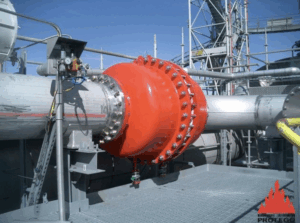
Flammable gas mixtures can burn in different ways, depending on their chemical composition, pressure, turbulence, and the shape of the space in which they ignite. These combustion behaviours are a critical consideration when designing protective devices such as flame arresters.
An explosion is a rapid oxidation or decomposition reaction that produces a sudden rise in temperature, pressure, or both. A deflagration is a type of explosion that travels at subsonic speed, while a detonation moves faster than the speed of sound.
In pipelines, an in-line deflagration is a flame front that moves along the axis of the pipe, preceded by a pressure wave. Its speed can range from slow to near sonic levels, influenced by factors such as the fuel-to-air ratio, pipe diameter, obstructions, and turbulence.
… to continue reading this article and more, please login, register for free, or consider subscribing to gasworld