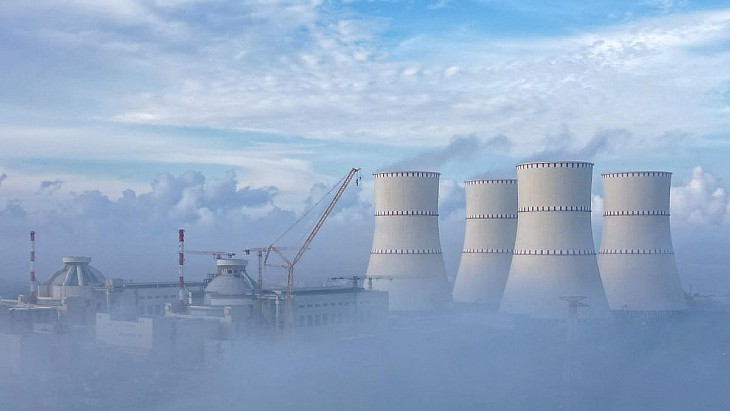
The Pre-Operational Safety Review Team (Pre-OSART) consisted of 14 experts from Bulgaria, China, Finland, France, Germany, Hungary, the UK and the USA plus International Atomic Energy Agency (IAEA) staff members and one observer from Russia. The mission, requested by the Bangladesh government, ran from 10 to 27 August.
The aim of such missions is to “assess safety performance against IAEA safety standards and advance operational safety through recommendations and suggestions”.
Areas of good practice to be shared with the global nuclear industry included “Rooppur Training Centre’s integration of a state-of-the-art simulator to train refuelling machine operators”.
Recommendations to “further improve safety” were to: enhance the fire safety arrangements and prevention measures to ensure effective mitigation of fire risk and effective fire response; improve the supervision, standards and conduct of plant operations; and strengthen the arrangements for equipment preservation during commissioning to ensure adequate protection of systems and components.
Simon Morgan, senior nuclear safety officer at the IAEA, said: “The transition from commissioning to operations is one of the most important stages for the safe operation of a nuclear power plant. The team observed a commitment from the plant management to assure that all the required pre-requisites are in place to enable this transition to take place safely and in accordance with national and IAEA standards.”
Kabir Hossain, Project Director of the Rooppur NPP, said: “Bangladesh is committed to achieving and sustaining high standards of the operational safety and reliability of its first nuclear power plant. This engagement with the Pre-OSART mission demonstrates the country’s dedication to building a safe and reliable nuclear facility and fostering a strong nuclear safety culture. Bangladesh views such IAEA peer review missions as a vital tool for self-assessment, allowing the country to evaluate its adherence to international safety standards and identify weaknesses in the national nuclear programme.”
During the visit the IAEA team held discussions with plant staff and reviewed operating practices in the areas of leadership and management for safety, training and qualification, operations, maintenance, technical support, operating experience, radiation protection, chemistry, emergency preparedness, accident management and commissioning.
The IAEA said: “The Pre-OSART team observed that the staff at the plant are knowledgeable, professional and committed to improving the operational safety and reliability of the plant. The team said that the technical exchanges with the plant’s staff were fruitful and that there was a good exchange of experience and knowledge on how the common goal of excellence in operational safety could be further enhanced.”
The Rooppur project
In February 2011 Russia’s Rosatom signed an agreement for two reactors to be built at Rooppur, about 160 kilometres from the capital Dhaka, for the Bangladesh Atomic Energy Commission. The initial contract for the project, worth USD12.65 billion, was signed in December 2015. The Bangladesh Atomic Regulatory Authority issued the first site licence for the Rooppur plant in June 2016, allowing preliminary site works, including geological surveys, to begin.
Construction of the first VVER-1200 unit began in November 2017. Construction of the second unit began in July 2018. They have an initial life-cycle of 60 years, with a further 20-year extension possible.
The first batch of nuclear fuel was delivered to the site in October 2023 – the moment that the site got its status as a nuclear facility. In March Rooppur unit 1’s turbine installation was completed, as were hydraulic tests to check the primary circuit systems and equipment, paving the way for hot functional tests to begin. Rosatom has included grid connection for Rooppur unit 1 as one of its key targets for the current year.