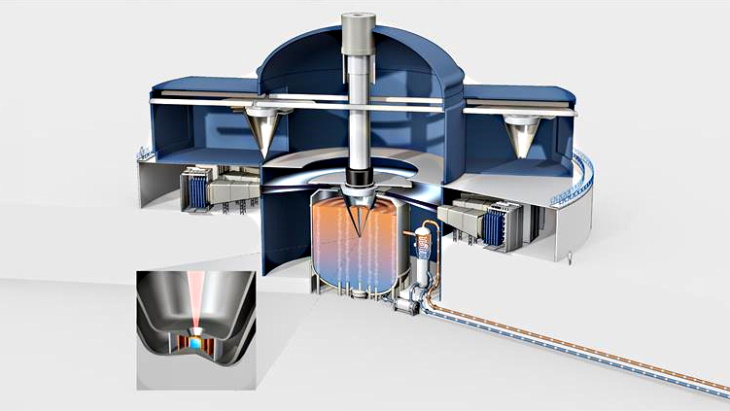
In its published today, First Light Fusion (FLF) outlines a novel and scientifically grounded approach to fusion energy called FLARE – Fusion via Low-power Assembly and Rapid Excitation. While the conventional inertial fusion energy (IFE) approach is to compress and heat the fuel at the same time to achieve ignition, FLARE splits this process into two: first compressing the fuel in a controlled and highly efficient manner and then using a separate process to ignite the compressed fuel, generating a massive surplus of energy, a concept known as ‘fast ignition’.
FLARE leverages over 14 years of First Light’s inertial fusion experience and its unique controlled-amplification technology, creating a system capable of reaching the high gain levels needed for cost competitive energy production. This new approach “would underpin the design for commercial reactors that can be based on much lower power systems that already exist today, opening up an opportunity for partners to build those systems, using FLF’s technology as the fuel, and to roll it out worldwide,” according to the company.
Gain – the ratio of energy output to energy input in a fusion reaction – is the critical metric determining commercial viability. The current record gain level stands at 4, achieved at the US Department of Energy’s National Ignition Facility (NIF) in May of this year.
“The FLARE concept, as detailed in today’s white paper, could produce an energy gain of up to 1000. FLF’s economic modelling suggests that a gain of at least 200 is needed for fusion energy to be commercially competitive, while a gain of 1000 would enable very low-cost power,” the company said.
According to FLF, an experimental gain scale facility is expected to cost one-twentieth that of NIF and could be built using existing, proven technologies. Due to the lower energy and power requirements provided by the FLARE technology, future commercial power plants would have significantly lower capital costs than other plausible IFE schemes, with lower complexity and core components such as the energy delivery system costing one-tenth of the capital cost of previous fast ignition schemes.
“By building on existing technology, First Light’s approach takes the brakes off inertial fusion deployment as it has the potential to leverage existing supply chains, significantly reduce capital expenditure, speed up planning approvals and reduce regulatory hurdles in the deployment of commercial fusion plants,” it said.
“This is a pivotal moment not just for First Light, but for the future of energy,” said First Light Fusion CEO Mark Thomas. “With the FLARE approach, we’ve laid out the world’s first commercially viable, reactor-compatible pathway to high gain inertial fusion – and it’s grounded in real science, proven technologies, and practical engineering.
“A pathway to a gain of 1000 puts us well beyond the threshold where fusion becomes economically transformative. Through our approach, we’re opening the door to a new industrial sector – and we want to bring others with us.”
First Light Fusion was founded by Yiannis Ventikos of the Mechanical Engineering Department at University College, London, and Nicholas Hawker, formerly an engineering lecturer at Lady Margaret Hall, Oxford. The company was spun out from the University of Oxford in July 2011, with seed capital from IP Group plc, Parkwalk Advisors Ltd and private investors. Invesco and OSI provided follow-on capital.
In February, Oxfordshire-based First Light Fusion announced it will focus on commercial partnerships with other fusion companies who want to use its amplifier technology, as well as with non-fusion applications such as NASA seeking to replicate potential high-velocity impacts in space. By dropping its plans for a fusion power plant, and instead targeting commercial partnerships with others, it aims to “capitalise on the huge inertial fusion energy market opportunities enabling earlier revenues and lowering the long-term funding requirement”.